
Sep 07, 2026
Hot Payrolls Print Slows the Digital Asset Rally
Weekly Index Highlights, September 7, 2026
Digital assets closed the week higher even after Friday's hot nonfarm payrolls report reversed a mid-week rally and revived Federal Reserve rate-hike bets. Every name in the CF Single Asset Series and every index in the CF Capitalization Series gained on the week, evidence that the payrolls-driven pullback dented but did not break the advance. Underneath that broad gain, Arbitrum's (ARB) 118.87% surge, tied to a run of on-chain records on Robinhood Chain, explains nearly all of the Infrastructure sub-category's reported outperformance and pushed the week's constituent-level dispersion to its widest point.
Market Performance Update
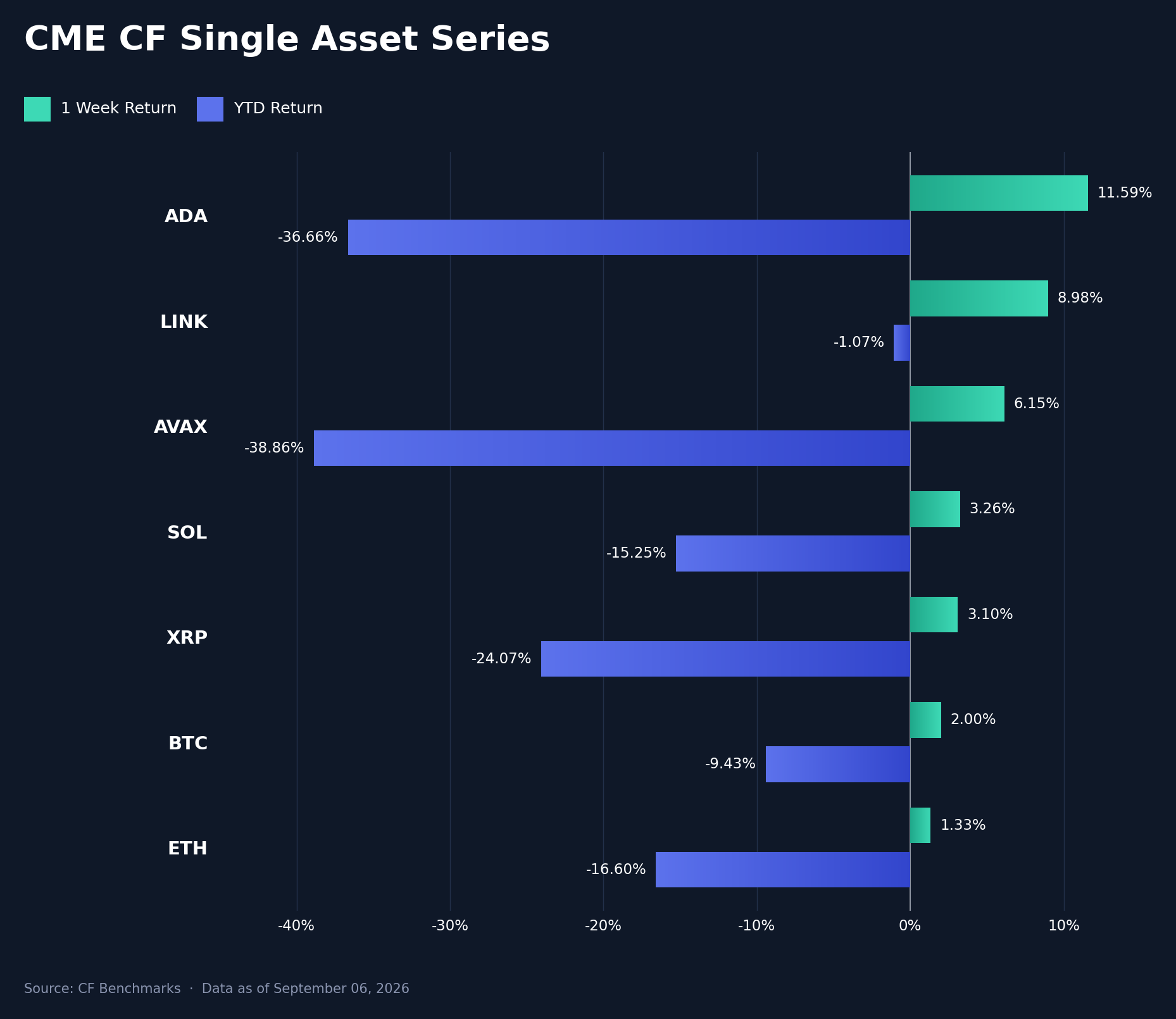
Bitcoin (BTC) extended the prior week's hawkish shock through Wednesday, drifting toward the mid-$76,000s as CME FedWatch-tracked September hike odds climbed to roughly 66%, before jumping as much as 6.8% intraday to a four-month high near $82,200 on Thursday after Fed Governor Christopher Waller signaled he would back holding rates steady absent a hot September 11 inflation print, sending hike odds down to roughly 48% to 50%. The week then closed on a hot nonfarm payrolls report that reversed the rally: August payrolls rose 162,000 against a 53,000-to-56,000 consensus, hike odds rebounded to roughly 58% to 59%, and BTC fell from the low $81,000s to a session low near $78,650 within the hour, with an estimated $200m to $295m of long positions liquidated. Even after that Friday pullback, BTC finished the week up 2.00% (year-to-date (YTD) -9.43%), and every other name in the CF Single Asset Series gained too, led by Cardano (ADA) at 11.59% (YTD -36.66%), Chainlink (LINK) at 8.98% (YTD -1.07%), Avalanche (AVAX) at 6.15% (YTD -38.86%), Solana (SOL) at 3.26% (YTD -15.25%), XRP at 3.10% (YTD -24.07%), and Ether (ETH) at 1.33% (YTD -16.60%), a 10.26 percentage point (pp) range from ADA to ETH. ADA's move is the sharpest reversal in the group: it closed the prior week as the worst performer at -8.46%, a 20.05 pp swing that says positioning, more than new information, drove the change. With hike odds back near 58% to 59% heading into the new week, markets now turn to the September 11 inflation print for a clearer read on the Federal Reserve's path into its September meeting.
Volatility Analysis
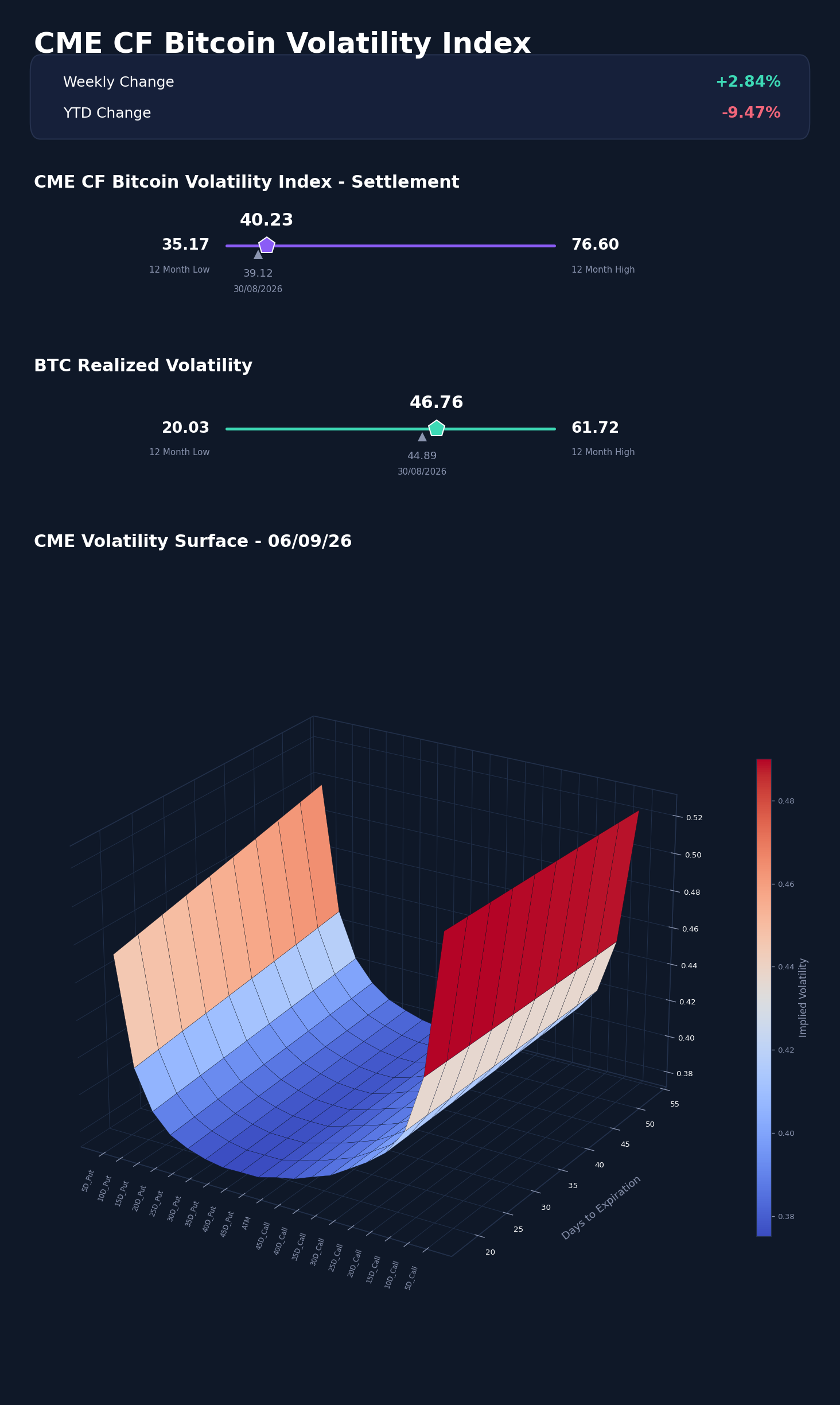
The CME CF Bitcoin Volatility Index Settlement (BVXS) rose to 40.23 from 39.12 a week earlier, a 2.84% week-on-week (w/w) gain that leaves it only 5.06 vol. points above its 12-month low of 35.17 and down 9.47% on a year-to-date (YTD) basis against the 44.44 start-of-year reference. Thirty-day realized volatility climbed further, to 46.76 from 44.89, widening the implied-realized spread to -6.53 vol. points from -5.77 a week earlier: the settlement index continues pricing less risk than the market is realizing, and that gap grew even as BVXS itself moved higher. The surface reshaped more than it shifted: at the shortest tenor available this week (18 days, versus 25 days a week earlier), the at-the-money (ATM) read rose 2.72 points to 37.77, the 5-delta put fell 11.83 points to 47.33, and the 5-delta call rose 5.49 points to 52.81, flipping the front-end wing structure from an 11.83-point put-side premium a week earlier to a 5.48-point call-side premium now, while the 25-delta put skew narrowed 1.52 points to just 0.16. The reshaping was more contained further out the curve: at the longest tenor available (53 days versus 60 days a week earlier), the put wing only narrowed, from 15.04 points to 11.81, and the call wing widened from 11.43 to 14.26, without crossing over. Puts got cheaper and calls got dearer across the curve in a week that closed higher, consistent with hedgers unwinding downside protection rather than paying up for fresh cover.
Market Cap Index Performance
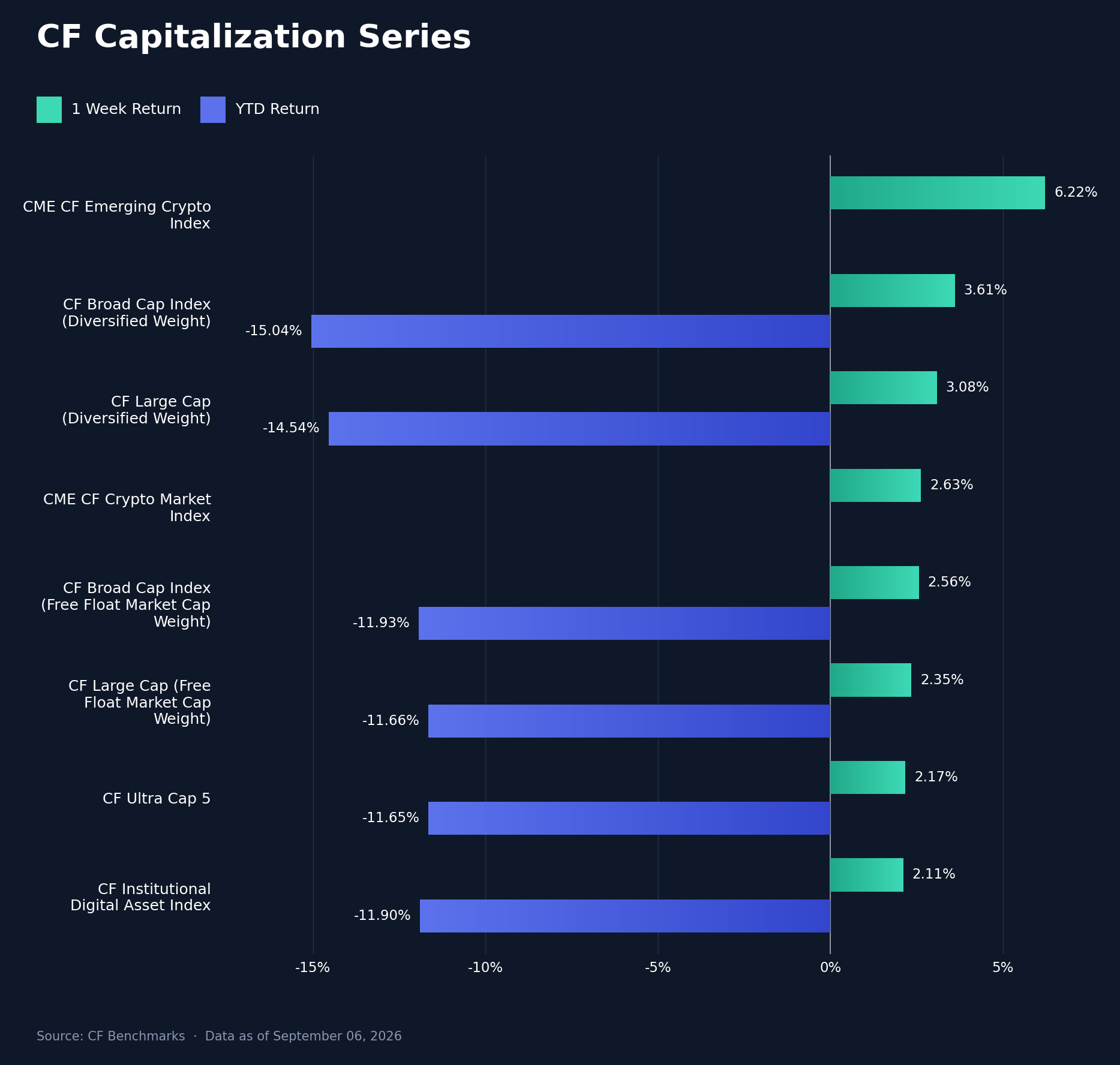
Digital assets moved broadly rather than rotating within the complex this week, and the CF Capitalization Series closed positive across all eight indices. The CME CF Emerging Crypto Index led at 6.22% w/w, followed by CF Broad Cap Index (Diversified Weight) at 3.61% (YTD -15.04%), CF Large Cap (Diversified Weight) at 3.08% (YTD -14.54%), the CME CF Crypto Market Index at 2.63%, CF Broad Cap Index (Free Float Market Cap Weight) at 2.56% (YTD -11.93%), CF Large Cap (Free Float Market Cap Weight) at 2.35% (YTD -11.66%), CF Ultra Cap 5 at 2.17% (YTD -11.65%), and the CF Institutional Digital Asset Index at 2.11% (YTD -11.90%), a spread of 4.11 pp between the best and worst index. YTD figures remain unavailable this week for the CME CF Crypto Market Index and CME CF Emerging Crypto Index because of the missing start-of-year basket fix flagged in prior editions; this is a data gap, not a change in either index's actual year-to-date standing. The diversified-weight indices again edged out their free-float counterparts: Large Cap Diversified beat Large Cap Free Float by 0.74 pp and Broad Cap Diversified beat Broad Cap Free Float by 1.05 pp, both spreads modest next to the week's gains. Spot Bitcoin ETFs took in roughly $987m of net inflows for the week, a third consecutive weekly inflow led by a $730m single-day intake on Thursday, the same session Governor Waller's remarks drove Bitcoin's rally to a four-month high, and demand held up through Friday's hot-payrolls reversal, when net inflows still added roughly $175m. Breadth holding together through Friday's reversal and ETF demand surviving it are the two pieces of evidence behind that read.
Factors Analysis
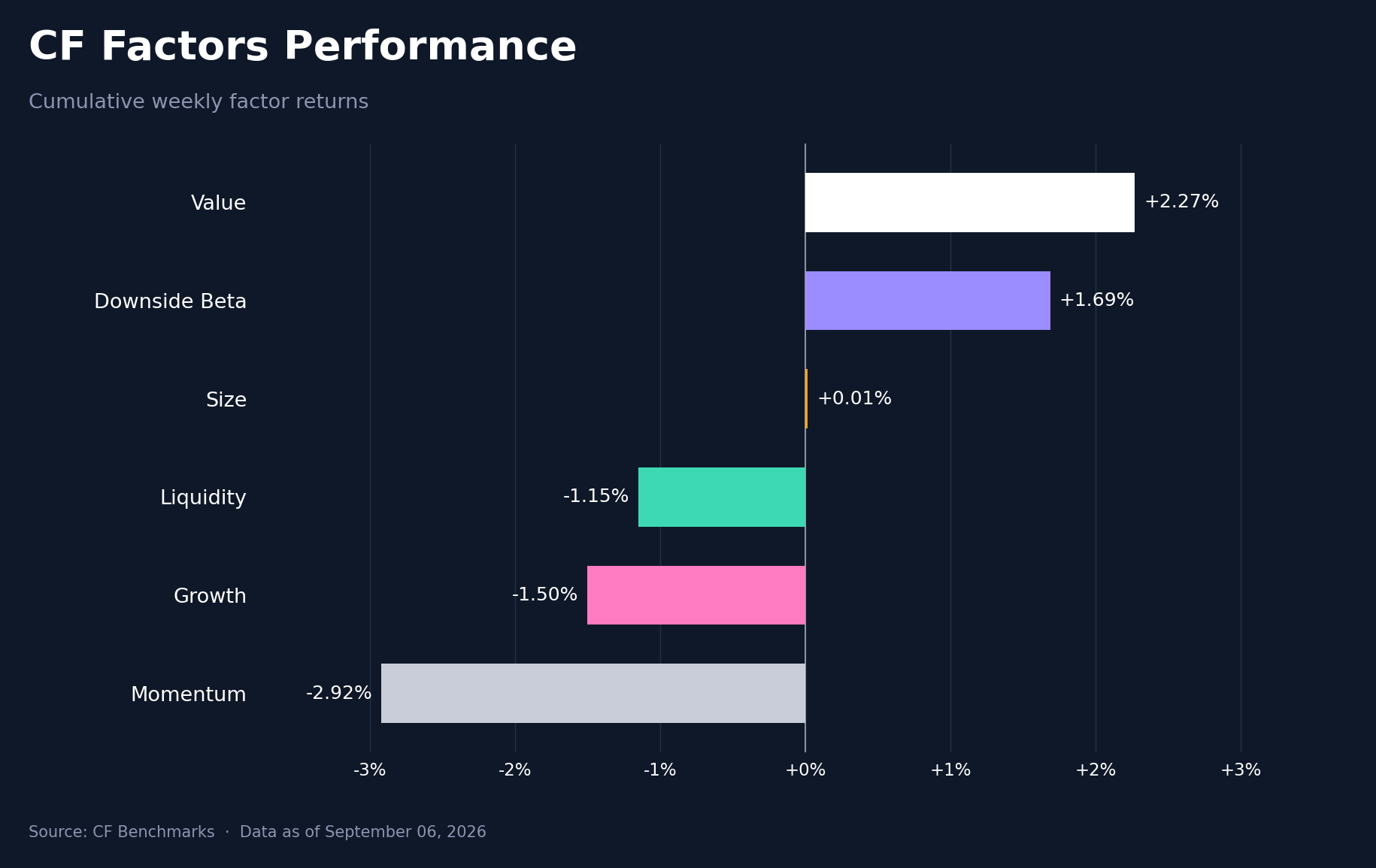
CF factor performance stayed muted relative to the week's Fed-driven price swings: Value again led the six factors, adding 2.27% cumulative for the week after leading the prior week too at 2.53%, the only factor to top the ranking twice running. Downside Beta followed at 1.69% and Size closed essentially flat at 0.01%, while Liquidity (-1.15%), Growth (-1.50%) and Momentum (-2.92%) lagged, a current-week range of 5.19 pp against 4.84 pp a week earlier. The bigger move was the rotation beneath that ranking: Momentum swung 3.56 pp lower, from +0.64% to -2.92%, the largest reversal in either direction, while Size swung 2.32 pp higher, from -2.31% to 0.01%, and Downside Beta added 1.61 pp to extend its own climb. Two straight weeks of Value leadership alongside a ranking that otherwise reshuffled top to bottom points to a market rewarding cheaper names consistently while momentum-driven positioning kept unwinding.
Read our latest weekly crypto factors report: Factor Friday - September 4, 2026
Classification Series Analysis
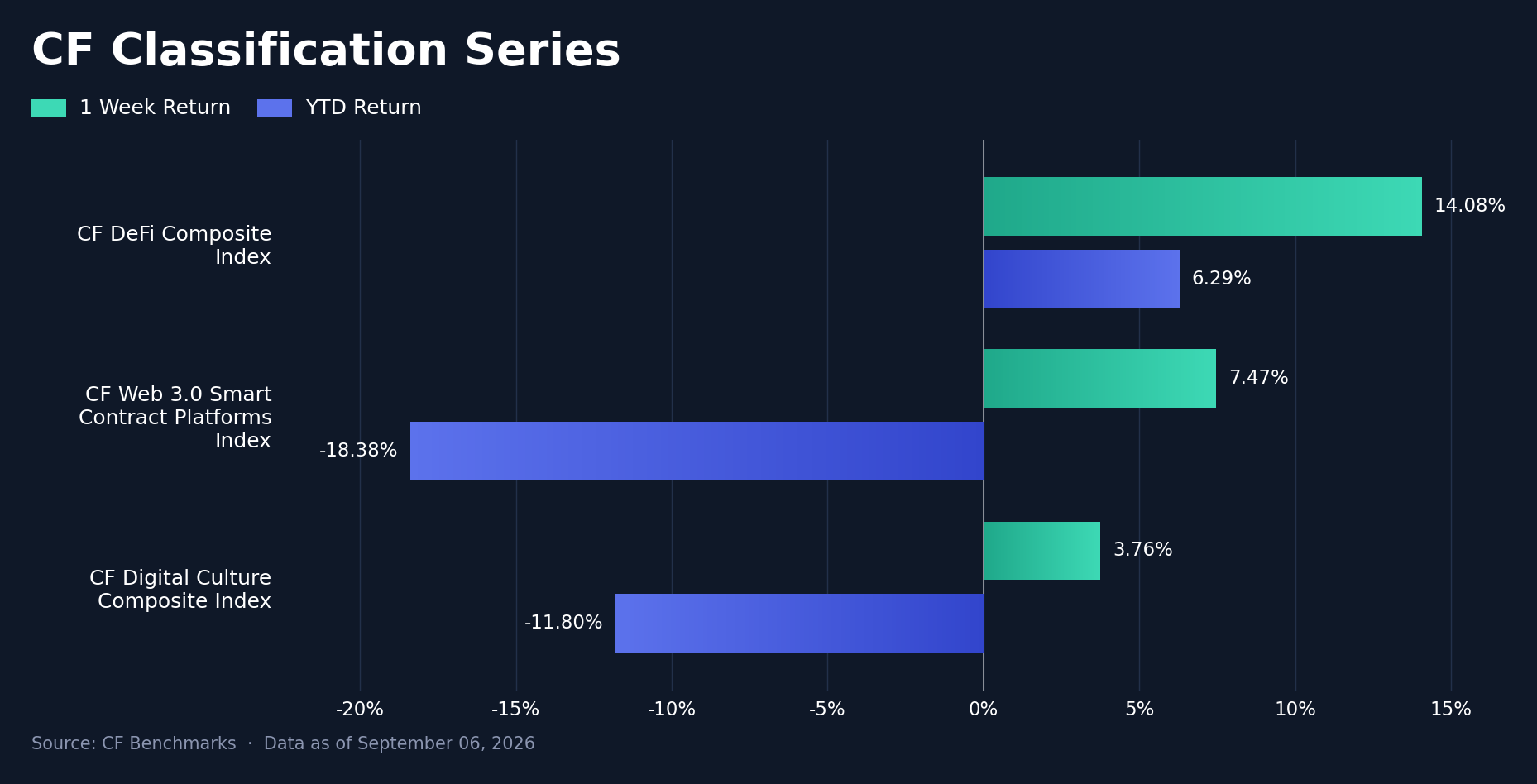
CF DeFi Composite Index led the three Classification Series composites by a wide margin, gaining 14.08% w/w and turning its YTD return positive at 6.29%, a reversal from -0.97% w/w a week earlier when it closed last among the three. CF Web 3.0 Smart Contract Platforms Index followed at 7.47% (YTD -18.38%) and CF Digital Culture Composite Index brought up the rear at 3.76% (YTD -11.80%), still a 10.32 pp gap between the leader and the laggard even though every composite gained. DeFi's reversal traces to the same trading-token strength that lifted CF DACS Finance this week (see Sector Analysis below): Uniswap (UNI) and Sushi (SUSHI), both Finance constituents, gained 35.03% and 27.84% respectively, evidence that the composite's move sits in its constituents rather than at the index level alone.
Sector Analysis
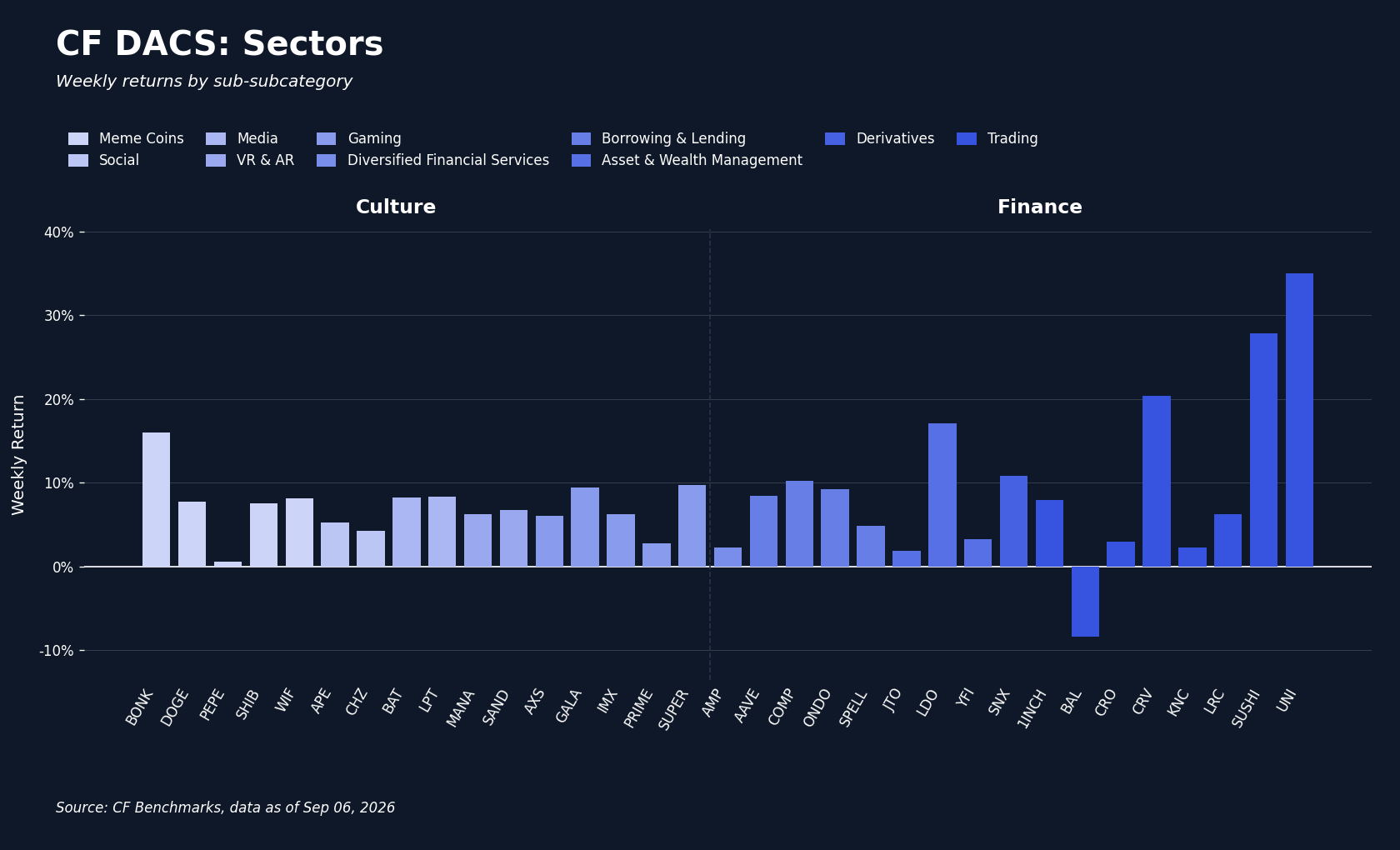
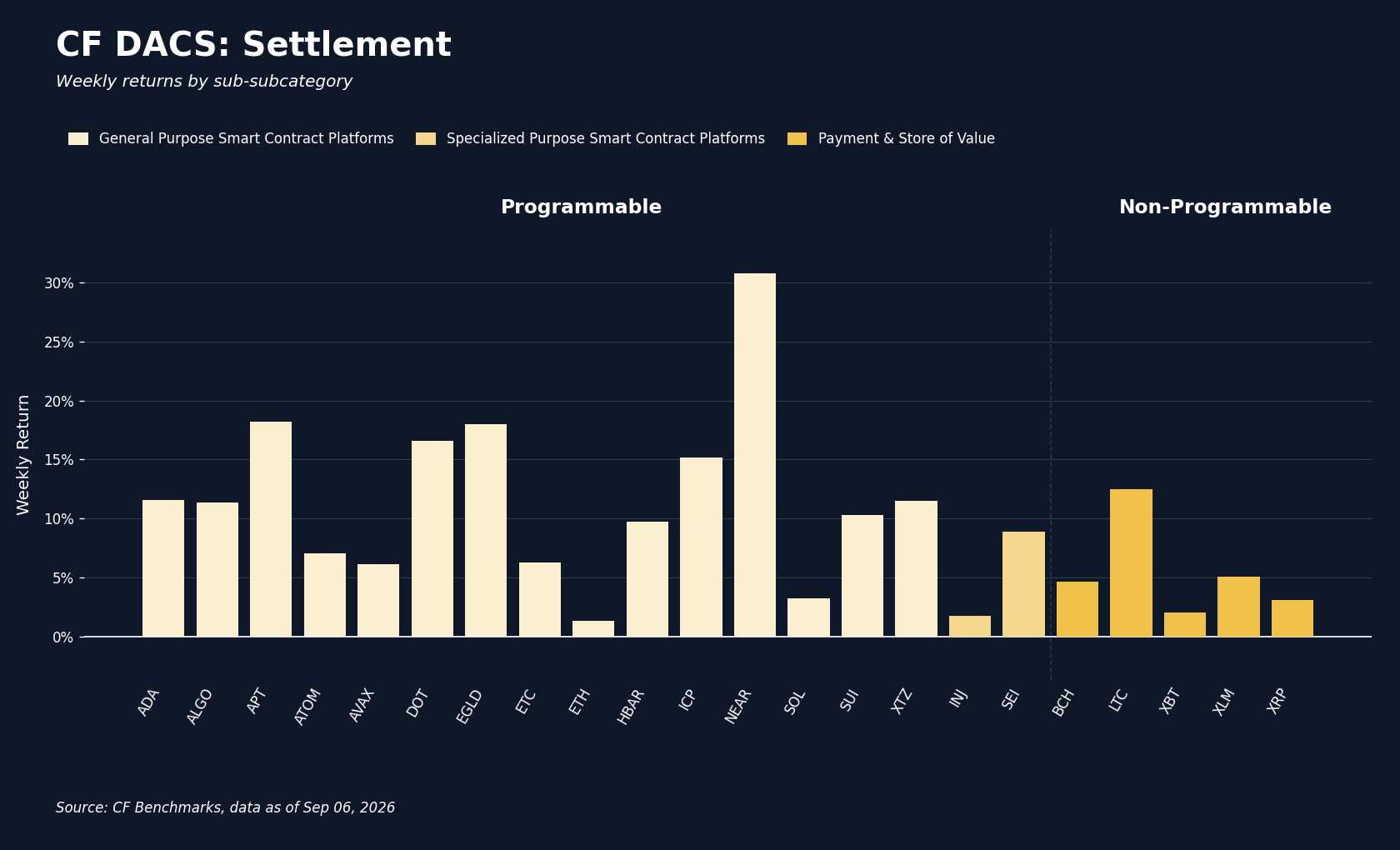
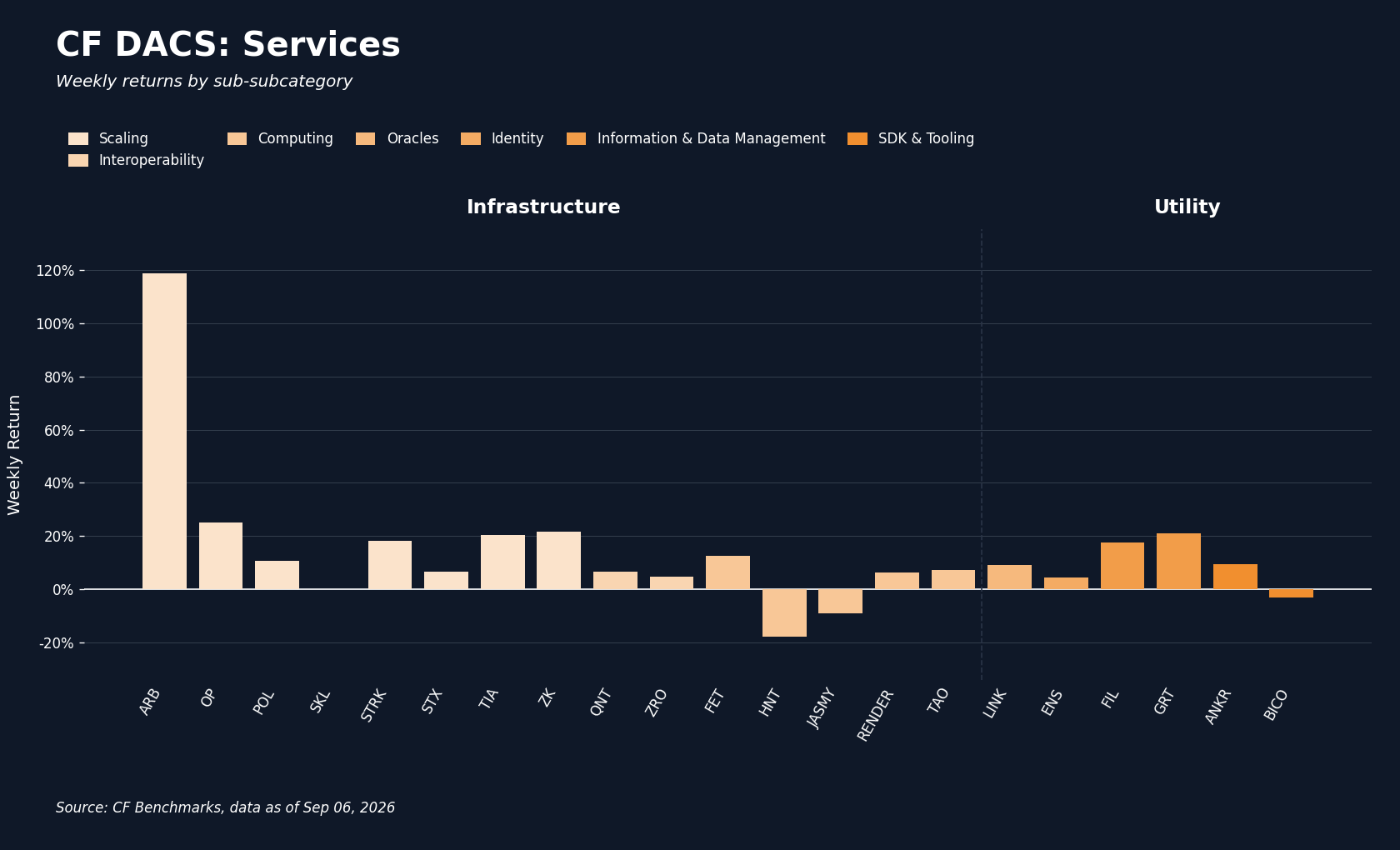
CF DACS Infrastructure led the six sub-categories at a nominal 15.48% average, but almost the entire gap belongs to one name: Arbitrum (ARB) rose 118.87% this week on the pricing basis used throughout this report (intraday industry reporting of the same move, sourced on a different basis, ran closer to 113.5%), an order of magnitude beyond any other constituent, after Robinhood Chain, the Arbitrum Orbit chain built by Robinhood, posted a fourth consecutive daily-fee record of $3.75m on September 1st, a figure that topped Ethereum mainnet's and Base's combined fees that day, and followed it with a $1.89bn single-day decentralized exchange (DEX) volume day on September 3rd that ranked second globally behind only Solana. Strip ARB out and Infrastructure's remaining fourteen constituents averaged 8.09%, in line with the other five sub-categories' averages (5.45% to 11.06%) rather than evidence of a sub-category-wide re-rating; one source flagged thin organic activity and elevated wash trading behind the September 1st intraday spike specifically, a caveat worth weighing against the dated, independently sourced on-chain records behind the broader weekly move. Utility (9.73%), Finance (9.57%) and Programmable (11.06%) all closed higher too, and all six sub-categories were positive this week, with Non-Programmable the laggard at 5.45%. Within Finance, Uniswap (UNI) led at 35.03% and Sushi (SUSHI) followed at 27.84%, trading-token strength broad enough that it also lifted the CF DeFi Composite Index to the top of the Classification Series (see above). Rarible (RARI), a Culture constituent, printed no weekly return this week, a Trino data gap rather than a market signal, and is excluded from the figures above. The widest constituent-level spread ran from ARB's 118.87% to Helium's (HNT) -17.71%, a 136.58 pp range across the seventy-six scored constituents that says more about one catalyst-driven move than about broad dispersion.
CF Staking Series
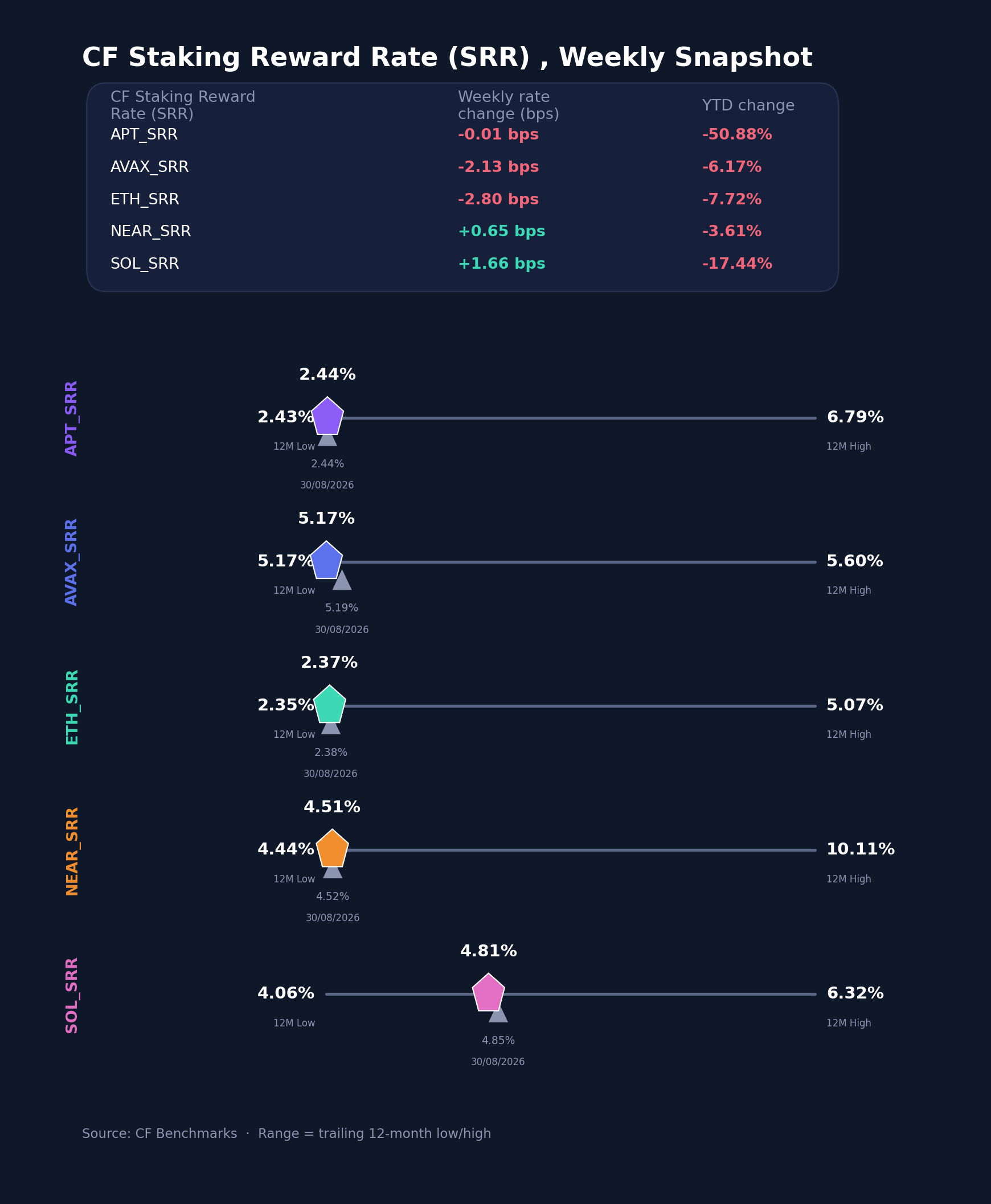
CF Staking Series relative index returns were mixed and modest against a week of shifting Federal Reserve rate expectations: Solana (SOL) led at 0.35% w/w, followed by Near Protocol (NEAR) at 0.14% and Aptos (APT) essentially flat at -0.00%, while Avalanche (AVAX) fell 0.41% and Ether (ETH) again lagged the group, down 1.17%. Reward-rate changes did not track index-return direction one for one: ETH's weekly reward-rate change was the largest of the five at -2.80 bps, its level slipping to 2.3701% from 2.3768% a week earlier, followed by AVAX at -2.13 bps (5.1722% from 5.1861%), NEAR at +0.65 bps (4.5127% from 4.5166%), SOL at +1.66 bps even as its own rate level fell to 4.8090% from 4.8541%, a timing gap between the within-week and week-over-week conventions consistent with the same quirk noted for BVXS in prior editions, and APT essentially flat at -0.01 bps (2.4380% from 2.4382%). Current reward-rate levels spanned 2.80 pp, from ETH's 2.3701% low to AVAX's 5.1722% high, an ordering unchanged from a week earlier.
Interest Rate Analysis
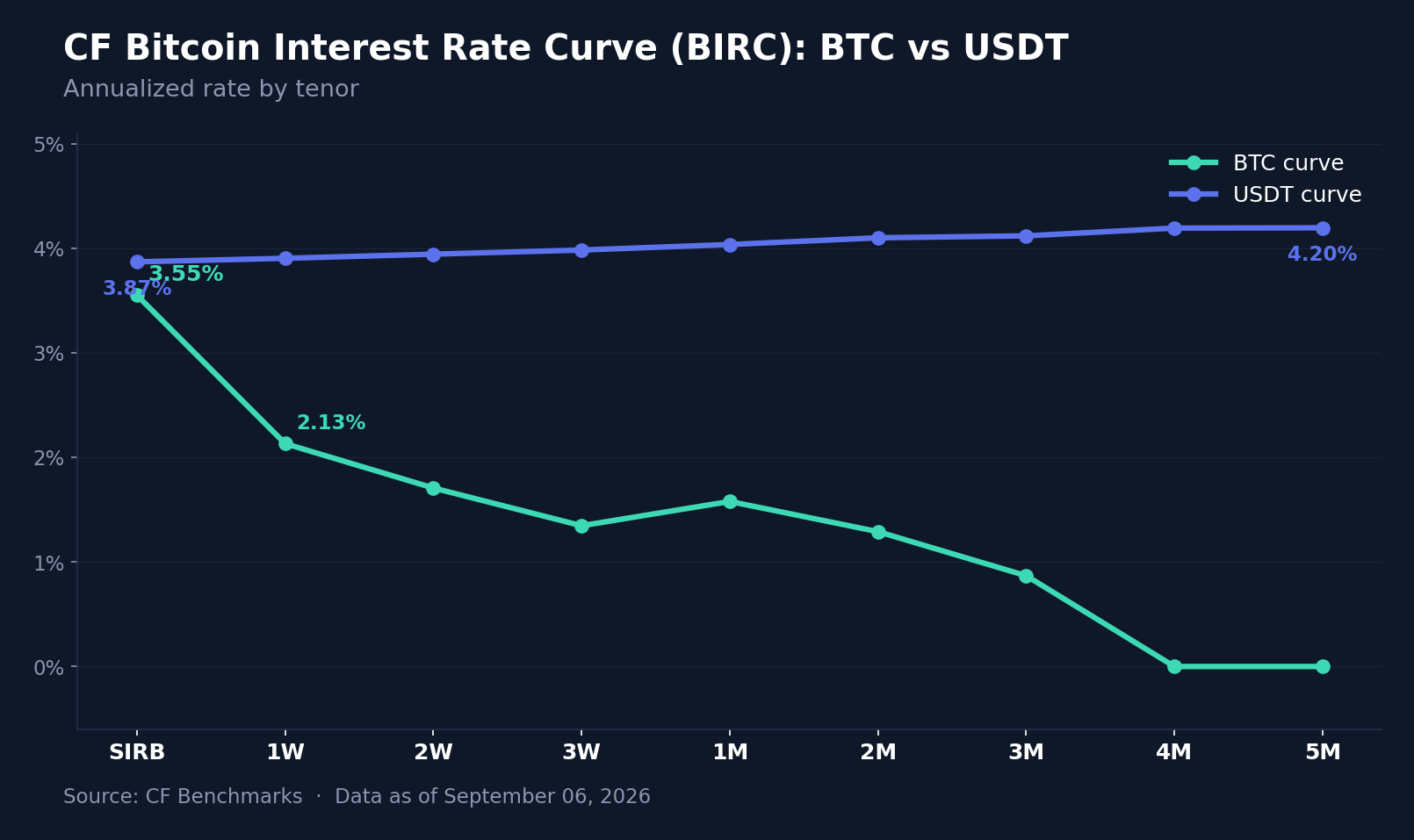
The BTC curve un-inverted at the front end this week, the opposite move from a week earlier: the Short-term Interest Rate Benchmark (SIRB) rose 64.6 bps to 3.5514% from 2.9055%, moving back above the 1-week (1W) tenor, which collapsed 196.9 bps to 2.1319% from 4.1005%, the largest single move on either curve. From there the BTC curve declined through 2-week (2W, 1.7076%, -164.5 bps) and 3-week (3W, 1.3468%, -125.9 bps) before an idiosyncratic hump at 1-month (1M, 1.5788%, -45.1 bps) that now prices above 3W, then resumed falling through 2-month (2M, 1.2900%, -28.3 bps) and 3-month (3M, 0.8683%, -29.5 bps) to 0.0000% at both 4-month (4M) and 5-month (5M). The USDT curve moved almost in parallel by comparison: every tenor rose between 20.9 bps and 27.3 bps, a 6.4 bps range against the BTC curve's 261.4 bps range from its biggest gain to its biggest loss. The BTC-versus-USDT differential widened sharply moving out from the front: 31.97 bps at SIRB versus 177.31 bps at 1W, evidence that this week's curve story is a BTC-specific reshaping rather than a shift in USDT term funding.
Closing Synthesis
This was a week where Federal Reserve rate expectations moved prices more than any single crypto-specific event, closing on a hot payrolls print that revived hike bets yet still left every name in the CF Single Asset Series and every index in the CF Capitalization Series higher, reversing a mostly negative prior week without concentrating the gain in one weighting scheme or cap tier. The more durable story sat one level down. Arbitrum's 118.87% surge, tied to Robinhood Chain's on-chain records, explains almost all of CF DACS Infrastructure's headline outperformance, and the CF DeFi Composite Index's move to the top of the Classification Series traces to the same trading-token strength visible in CF DACS Finance. The BTC interest-rate curve un-inverted at the front end as sharply as it had inverted a week earlier, and the volatility surface's wing structure flipped from put-skewed to call-skewed at the short end even as BVXS itself drifted only 2.84% higher. With the Federal Reserve's next move now resting on the September 11 inflation print, the more specific stories, one token, one sub-category, one segment of the curve, carried this week's real dispersion beneath a broadly positive close.
The information contained within is for educational and informational purposes ONLY. It is not intended nor should it be considered an invitation or inducement to buy or sell any of the underlying instruments cited including but not limited to cryptoassets, financial instruments or any instruments that reference any index provided by CF Benchmarks Ltd. This communication is not intended to persuade or incite you to buy or sell security or securities noted within. Any commentary provided is the opinion of the author and should not be considered a personalised recommendation. Please contact your financial adviser or professional before making an investment decision.
Note: Some of the underlying instruments cited within this material may be restricted to certain customer categories in certain jurisdictions.
Changes to the Token Market Price Benchmarks Series - Market Prices – 20 October 2026
The Administrator has confirmed changes to the Token Market Price Family for the period 13 October 2026 to 20 October 2026

CF Benchmarks
Altcoins Lag as Bitcoin Tests The 50-Day Moving Average
Digital assets fell broadly over the past week as Bitcoin slipped to a moving average, with inflation prints and an equity sell-off in the background. Losses grew with distance from Bitcoin, hitting diversified and smaller-cap exposure hardest, while implied volatility rose.
Mark Pilipczuk
Factor Friday - October 16, 2026
Size led the factor table for a third week at 0.59% as the Market rebounded 0.40% and 15 of 35 Broad Cap tokens closed higher. Momentum fell 1.58% in a rebound led by laggards, and Size's weekly print has narrowed from 8.86% to 0.59% in three weeks, even as its year-to-date lead holds at 22.81%.
Mark Pilipczuk
By clicking Accept, you consent to CF Benchmarks's use of cookies.
Visit Cookie Settings to learn how CF Benchmarks uses cookies and to adjust your preferences.