
Dec 31, 2025
CF Benchmarks Newsletter Issue 98
Wall
Approaching the two-year mark of the first U.S. spot Bitcoin ETFs seems like a reasonable juncture to review the current state of live crypto ETF filings for the last time in 2025.
Here’s the best-known list, as shared by Bloomberg’s James Seyffart and Eric Balchunas:
That said -- we expect liquidations to pick up too. Not sure the liquidation numbers can stay this low for US ETPs as launches explode
— James Seyffart (@JSeyff) December 11, 2025
If you're a Bloomberg terminal client and interested in seeing these charts and more, the report can be found here: https://t.co/ELvRQ1lTtS pic.twitter.com/drrGxC4BjI
Bitcoin Malaise
The backdrop is overshadowed by the market’s anchoring asset, Bitcoin, floundering about 0.9 of a standard deviation below its circa $126k record.
(See NYU’s GARCH model here for the calculation. Note: ~1𝛔/1-year BTC drawdowns are historically normative for BTC.)
The market might look different by the time the SEC works through this wall of filings. At least for now though, this is the climate into which issuers are intent on pumping more inventory.
Liquidations Likely
That adds backing to a first high-probability assumption on the trend of listed crypto products in 2026, as noted by the Bloomberg analysts: liquidations are likely to increase.
With a reasonable level of U.S. crypto ETF attrition already emerging over the last several months, further ‘wastage’ would not be surprising.
It is the concentration of interest in specific assets, the overall tenor of the filings slate, plus the regulatory undercurrents facilitating this stepped-up wave of paperwork that are more interesting.
We’ll take a closer look at these points a little lower down.
The forward-looking view on the 2026 crypto ETF landscape that you’re currently reading is nowhere near The Big Picture for the year ahead.
Luckily, CF Benchmarks’ Market Outlook 2026 has just landed.
In ‘Risk-On Reloaded: Monetary Easing, Catch-up Trades, and the Tokenization Buildout’, Head of Research Gabe Selby, CFA and Research Analyst Mark Pilipczuk, guide us through what’s expected to be a “transformative” year.
- Learn how resilient underlying growth offers a surprisingly positive kick-off despite challenging labor trends
- What to make of an increasingly complex Fed picture - before a likely new dovish chair is installed
- Why “Tokenization” is the keyword for the 2026 Regulatory Outlook
- How 'Altcoin Season' is set to make a return
- Plus, consensus forecasts and portfolio perspectives
All in all, our Market Outlook 2026 is one of the few freely available institutional-grade outlook reports focused on digital assets.
Click below to read or download the report.
Get the summary:
 Gabriel Selby
What a Huge Wall of Filings Tells us about the Next Wave of US Crypto ETFs
Judging by the massive raft of live filings, US crypto ETF launches are poised to accelerate in 2026, as many familiar trends continue - and a surprising new one emerges
It was the instigation of Generic Listing Standards (GLS) in September that formalized the more accommodative but still prudent regulatory pathways needed for the asset class to grow way beyond Bitcoin and Ether within exchange listed wrappers.
Click below to read a concise overview of Generic Listing Standards by CF Benchmarks Head of Research Gabe Selby, CFA.
 Gabriel Selby
GLS Triggers More
Now, as the list we shared above shows, issuers are building a dense pipeline across dozens of tokens—anchored by persistent demand for BTC and ETH, and an ascendant second tier led by SOL and XRP.
This means the competitive edge is migrating away from “getting exposure” and toward how exposure is engineered: including eligibility signals, governance-grade benchmarks – like those published by CF Benchmarks, with demonstrably representative liquidity – increasingly all alongside staking and yield design.
Worth underlining: Bloomberg’s early-December tally was only a snapshot. At the time of writing at the end of December, the count has risen, if not materially. We’ve kept the cut-off as December 11th, while acknowledging that the tenor of the list could soon change.
Concentration
With a broader palette of ETF-eligible crypto assets now fully telegraphed by the SEC, it’s helpful to take a closer look at the filings slate to get an idea of what applicants are doing with this broader permission—i.e., where issuer focus has been concentrating.
Where filings are clustered
Issuer attention is now split between what we can describe as:
- Core allocation exposures: the assets and structures issuers expect to sit at the centre of mainstream portfolios—high-liquidity, institutionally legible exposures where competition is increasingly about wrapper design (fees, structure, distribution) rather than “does this belong?”
- Second tier exposures: the next set of protocol bets that sponsors are positioning as plausible “portfolio primitives” beyond BTC/ETH—still relatively liquid and widely held, but where regulatory eligibility, market-structure maturity, and standardization (benchmarks, custody, surveillance) are more determinative of the path to scalable distribution.
- “Optionality” filings: these are a ‘long tail’ of opportunistic filings, aiming to test the eligibility boundary, and distribution appetites.
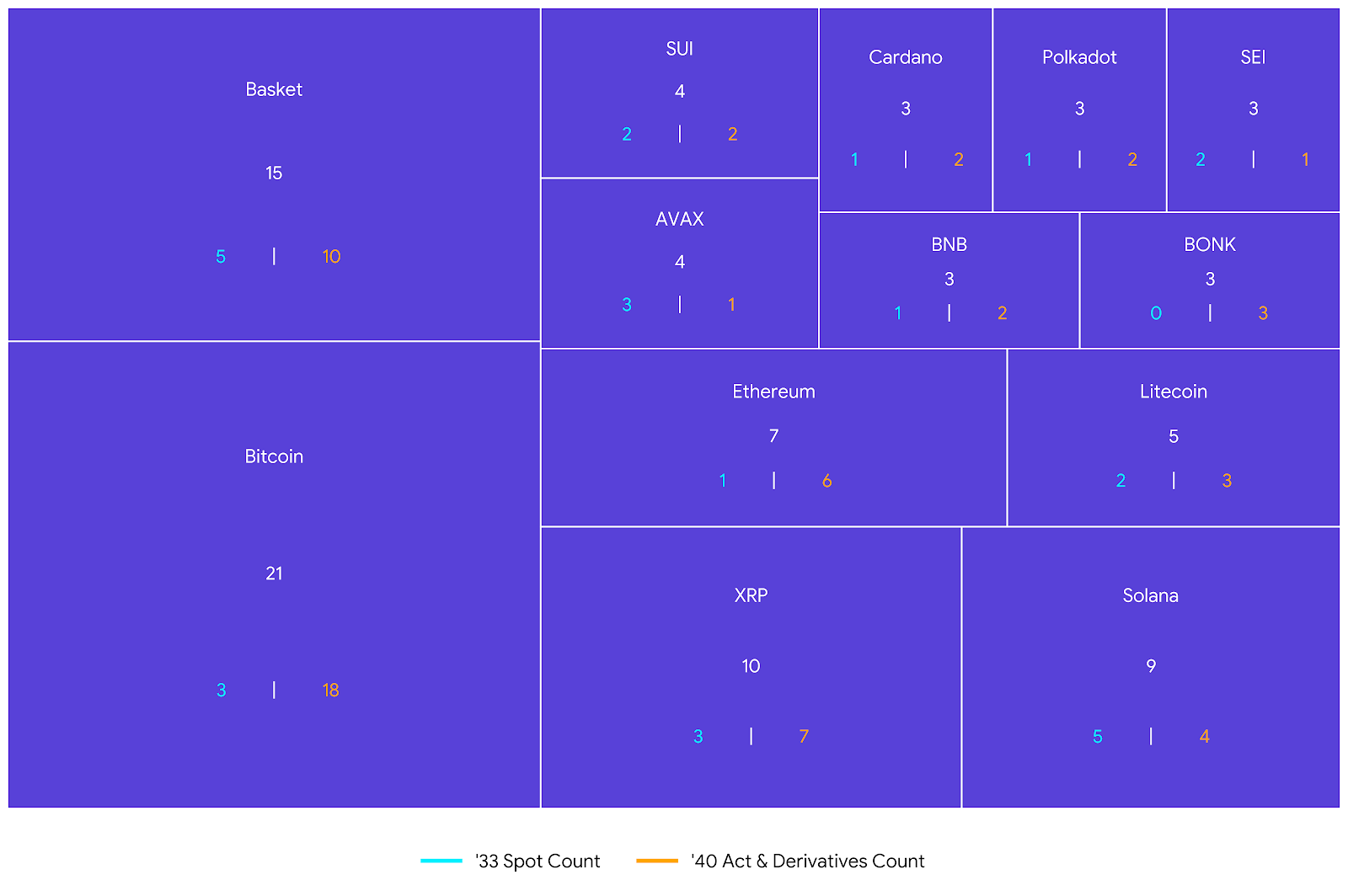
To facilitate our absorption of of these clusters further, we’ve repackaged the filings slate into the ‘heat map’ below.
Active crypto asset ETP filings by asset as of December 11th, 2025
The Obvious Takeaways
They're still worth noting.
- Catalogue expansion: This voluminous filing count reflects the impact of the hard-won regulatory gains of the past few years: chiefly evidenced by strengthened issuer confidence. Sponsors now view crypto ETPs as a repeatable manufacturing process.
- ‘Core beta’ additions: While BTC and ETH axiomatically remain ‘core beta,’ it’s also clear that SOL and XRP have become the next most crowded tier of mainstream demand.
- Baskets are the institutional format: The rise of rules-based multi-asset construction is coinciding with indications that distribution is slowly beginning to move onto platforms and model portfolios. No causality can be claimed for now, but fiduciaries’ historical preference for diversified exposure is well documented.
The Surprising ’40 Act Fightback
It’s when we examine the ‘regulatory lanes’ where live filings are pooling that the most surprising and counter-intuitive concentration emerges.
With the snapshot showing 124 filings, split between 42 ’33 Act spot applications, and 82 proposed ’40 Act spot and/or derivatives-based funds, the bias is clear.
It’s important to outline why these new signs of ’40 Act prevalence go against the grain and the direction of travel for crypto ETPs.
Crypto’s ’33 / ’40 Inversion
First off, note that for traditional assets (stocks, bonds, etc.) – investors have historically favored ’40 Act ETPs over ’33 Act ETPs. Crudely speaking, investors have generally regarded investor safeguards as higher in the former vs. the latter.
One major observation from the relatively short history of crypto ETPs though, is that the trend and apparent market preference have generally been in the opposite direction.
Read on here

Building Bitcoin Capital Market Assumptions: an institutional framework for allocation
A Primer For the Full Report
Here, we feature a summary and excerpts from the CF Benchmarks Capital Market Assumptions report on Bitcoin, produced by Head of Research Gabe Selby, CFA and Research Analyst Mark Pilipczuk.
Bitcoin CMAs Long Overdue
Capital market assumptions (CMAs) are the institutional “operating system” for strategic allocation: they convert an investment thesis into the inputs that portfolio construction and governance actually require—expected return, volatility, and correlation.
CMAs carry real weight. Because they can eventually be backed by real money. Their purpose is to make assumptions explicit, so committees can debate scenarios and sensitivities with discipline.
For Bitcoin, that discipline is especially important: outcomes are non-Gaussian, market structure has been evolving quickly, and the difference between a view and an implementable allocation is a framework that can be monitored and updated over time.
CMAs are the bridge between an investment thesis and portfolio weights: expected return, risk, and correlation inputs that governance bodies can debate and implement.
A new research report by the CF Benchmarks Research Team proposes a pragmatic Bitcoin CMA framework spanning strategic (1–10 years) and tactical (sub-1 year) horizons, integrating multiple lenses to support disciplined sizing and risk management.
- Ensemble CMA: three lenses (adoption, production, liquidity).
- Probabilistic base case: scenarios + weights make assumptions governable.
- Evolving risk: volatility and correlations are treated as structural, undateable inputs.
- Portfolio-ready: modest, constrained allocations can still improve efficiency.
Four takeaways
1) The CMA is multi-model
The framework combines comparative valuation (store-of-value share vs gold), production economics (cost-of-production regimes), and a liquidity overlay (global M2) to avoid over-reliance on any single story.
2) The base case is probability-weighted
Rather than a single asserted path, long-run outcomes are framed via scenarios and weights—so committees can interrogate assumptions (scenario weights, gold growth assumptions, penetration paths) rather than debate narratives.
3) Risk is structurally evolving
The risk framework emphasizes volatility compression and evolving correlation dynamics as market structure deepens—positioning risk assumptions as something to be updated.
4) Portfolio relevance shows up at even modest weights
Using its CMA inputs (expected return / volatility / correlations), the report argues that even constrained allocations can improve portfolio efficiency—shifting focus toward implementable sizing under real governance constraints.
The institutional through-line:
“This combination of high expected returns, moderating volatility, and persistently low correlations positions Bitcoin as a compelling addition to a multi-asset portfolio.”
From 'Building Bitcoin Capital Market Assumptions: A Practitioners Framework for Strategic and Tactical Allocations' by Gabe Selby, CFA and Mark Pilipczuk
Bitcoin vs. Cost of Production
Figure 8 (below) is an “at-a-glance” illustration of how the report treats valuation tactically, eschewing precision fair-value calls, in favor of regime profiles.
In the model illustrated below, when price trades materially below estimated production cost, conditions have historically reflected stress; near cost suggests equilibrium; far-above cost reflects elevated valuations – where sizing discipline and risk management matter most.
With this approach, production cost defines a useful reference range that can be combined with other lenses (e.g., comparative valuation and liquidity) to reduce decision noise and support repeatable, governed process.

Kraken Launches LCAP Perpetual Futures, Expanding Access to Regulated On-Chain Crypto Index Exposure

CF Benchmarks' regulated CF Large Cap index is now available as a perp for the first time.
CFB Powers Kraken’s First Portfolio-Based Perp
CF Benchmarks congratulates Kraken on the successful launch of its Large Cap DTF Perpetual (PF_LCAPUSD) futures contract, referencing the LCAP DTF deployed on the Reserve Protocol, marking Kraken’s first perpetual futures contract offering multi-token exposure.
As the digital asset derivatives landscape continues to evolve beyond single-asset products, this latest inflection point reflects growing demand for instruments that offer diversified exposure, capital efficiency, backed by institutional-grade reference standards.
Against this backdrop, Kraken has today launched a perpetual futures contract referencing the LCAP Decentralized Token Folio (DTF), broadening access to one of the market’s most institutionally aligned on-chain crypto portfolios.
The launch represents a further extension of the LCAP ecosystem following the deployment of the LCAP DTF as an on-chain spot instrument earlier this year.
The contract is based on the Large Cap DTF (LCAP). In turn, LCAP references the CF Large Cap (Diversified Weight) – US – Settlement Price, a CF Benchmarks index designed to represent the large-cap segment of the crypto asset market through a transparent, rules-based, and regulator-aligned methodology.
Kraken’s First Multi-Token Perpetual
While multi-asset indices are well established in traditional finance, their adoption within crypto derivatives remains nascent. The LCAP perpetual represents Kraken’s first perpetual futures contract referencing a diversified, multi-token crypto portfolio, signaling growing market maturity and demand for index-based derivatives beyond single-asset BTC and ETH products.
Importantly, this development should be viewed less as a platform milestone in isolation, and more as evidence of the expanding role that benchmark-driven crypto portfolios can play across spot, on-chain, and derivatives markets.
Key Contract Specifications
- Ticker: PF_LCAPUSD
- Base Asset: LCAP – Large Cap DTF
- Quote Currency: USD
- Tick Size: 0.001
- Minimum Lot: 0.1
- Maximum Position Size: 300,000 LCAP
- Margin Class: Class D (up to 20x leverage)
- Collateral Currencies: USD, BTC, and 40+ additional assets
(Note: contract specifications and trading conditions are determined and administered by Kraken.)
Read the full launch post here.
The information contained within is for educational and informational purposes ONLY. It is not intended nor should it be considered an invitation or inducement to buy or sell any of the underlying instruments cited including but not limited to cryptoassets, financial instruments or any instruments that reference any index provided by CF Benchmarks Ltd. This communication is not intended to persuade or incite you to buy or sell security or securities noted within. Any commentary provided is the opinion of the author and should not be considered a personalised recommendation. Please contact your financial adviser or professional before making an investment decision.
Note: Some of the underlying instruments cited within this material may be restricted to certain customer categories in certain jurisdictions.
Factor Friday - October 9, 2026
Size led CF Benchmarks' factor table for a second week at 2.58% as the Market fell 4.98%. Size held after QNT's reversal, though its cohort spread narrows sharply without three outlier tokens, and Downside Beta and Liquidity gave back part of last week's gains.

Mark Pilipczuk
Small Cap Tokens Outperform in September
The CF Free-Float Broad Cap Index rose 10.28% in September as Bitcoin supplied 59% of the gain while trailing the index. Returns across the Capitalization Series ran from +7.74% for Ultra Cap 5 to +14.01% for Emerging Crypto, which holds no Bitcoin, as altcoins outpaced Bitcoin.
Mark Pilipczuk
CF Digital Asset Index Family Multi Asset Series – Extraordinary Rebalance Announcement
CF Digital Asset Index Family Multi Asset Series - Extraordinary Rebalance Announcement
CF Benchmarks
By clicking Accept, you consent to CF Benchmarks's use of cookies.
Visit Cookie Settings to learn how CF Benchmarks uses cookies and to adjust your preferences.