
Oct 27, 2026
Who Signs the Price: The CME CF Real Time Indices Through CFB Oracle
Onchain markets that settle against a price need a price that survives a challenge. Speed and uptime are the entry requirements. The harder questions are how much capital sits behind the number, who calculated it under which published rules, and who answers for it afterward. The GENIUS Act, signed on 18 July 2025, set the first federal framework for payment stablecoins, and bitcoin event contracts already trade on venues regulated by the Commodity Futures Trading Commission (CFTC). Onchain venues that move toward the same perimeter will need an answer to each of those questions.
The BRTI is one answer. It consolidates the order books of seven constituent exchanges, applies published screens to each calculation, and is administered under the UK Benchmarks Regulation (BMR). Between 1 October 2025 and 8 October 2026, the consolidated book held a median of $27.7 million within 0.1% of the midpoint, bids and asks combined, with $20.2 million at the 5th percentile. Within 1% it held a median of at least $71.5 million. The same index family already sets prices that US regulated venues settle against, including bitcoin futures at CME Group and event contracts at Kalshi and ForecastEx.
CFB Oracle makes those indices usable onchain, unchanged, and adds a CF Benchmarks signature to each value. The launch set is 177 indices across crypto, equities, commodities, FX, and staking and rates. Attested values have been available to clients through the CF Benchmarks API since 31 August 2026, and CFB Oracle launches publicly on 27 October 2026, with onchain verification live on Ethereum, HyperEVM and Robinhood Chain. This paper covers the liquidity behind the BRTI, how its methodology defends the price, how CFB Oracle differs from incumbent oracles, and where it stops. Section 9 gives a short overview of the wider index set.
Disclosure. CF Benchmarks is part of Payward, Inc., which owns and operates the Kraken exchange and built Ink, an Ethereum Layer 2 network. Kraken is a constituent exchange and a source of input data for the BRTI, as the CF Benchmarks constituent exchange list discloses.
Where the regulated price already sits
CF Benchmarks administers four related bitcoin indices, and they do different jobs.

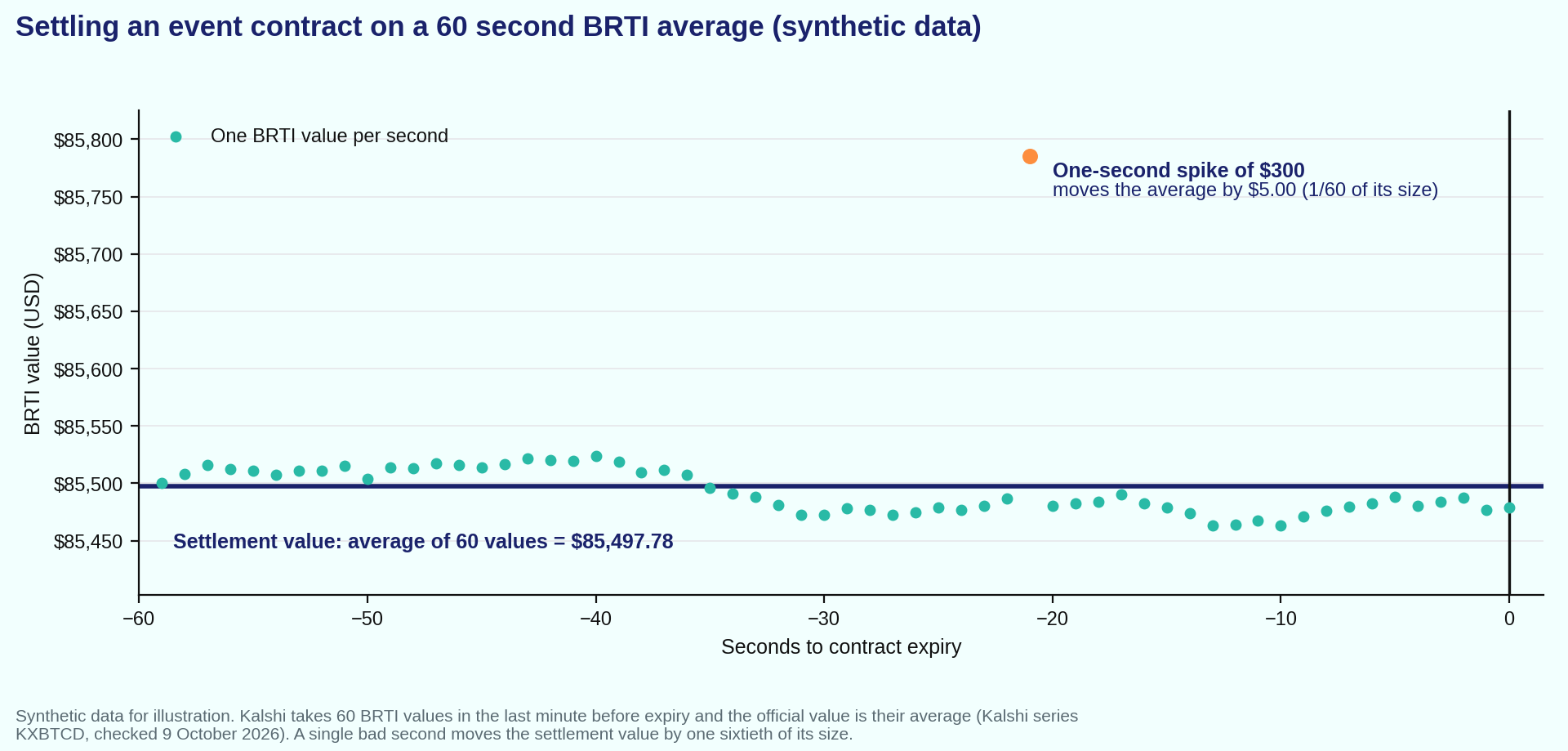
Kalshi's published contract terms show the construction. Its bitcoin contracts take 60 BRTI values in the last minute before expiry, and the official value is their average (Kalshi, series KXBTCD, checked 9 October 2026). ForecastEx's period high and low contracts settle to a CF Benchmarks cryptocurrency Real Time Index. For each minute, the highest 20% and lowest 20% of index values are dropped and the middle 60% are averaged, and the contract resolves on the highest or lowest of those per-minute values in the period (ForecastEx rule filing with the CFTC, 9 January 2026). The two venues use different averaging rules on CF Benchmarks Real Time Indices.
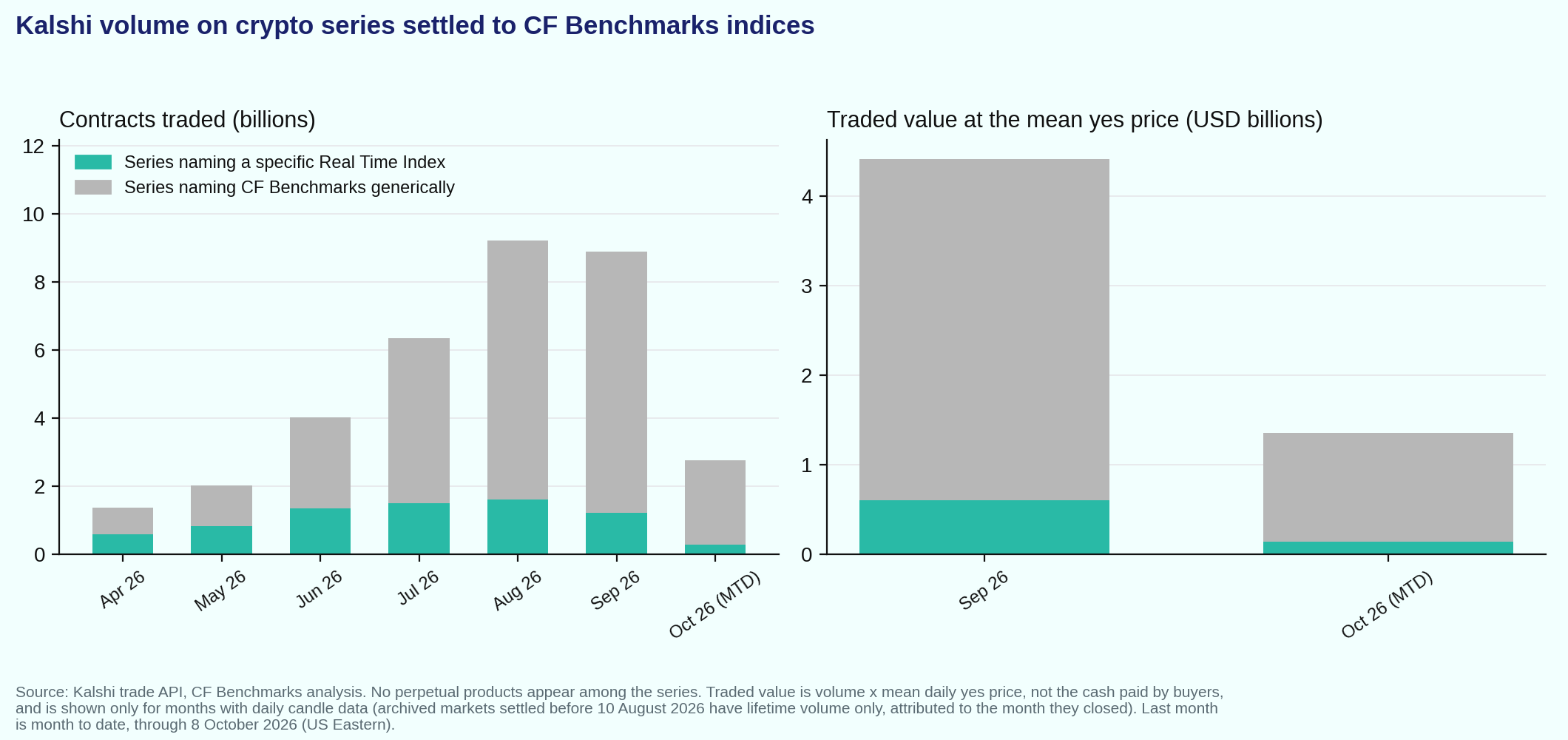
The reach is broad. Kalshi's public series list names CF Benchmarks as a settlement source for 191 crypto series, across bitcoin, ether, solana, XRP, dogecoin and others. Of these, 78 link a specific Real Time Index and 113 name CF Benchmarks without a specific index (Kalshi API, 9 October 2026). Event contract volume is large. Contracts traded on all CF Benchmarks-named series rose from 1.4 billion in April 2026 to 9.2 billion in August and 8.9 billion in September. Kalshi archives markets settled before 10 August 2026 without daily data, so their volume is counted in the month the market closed. DeFi Rate tracks 65.8 billion Kalshi contracts traded across all categories in the 30 days to 8 October 2026, against $15.6 billion paid in premium (DeFi Rate, 8 October). Contracts and cash paid are different measures, and the all-category total includes sports, so it overstates the crypto footprint. Across all 191 series that name CF Benchmarks, Kalshi traded about 9.5 billion contracts in the 30 days to 8 October 2026, about 14% of the all-category total, with an approximate traded value of $4.7 billion at the mean yes price. The 78 series that link a specific Real Time Index account for about 1.2 billion of those contracts, roughly 2% of the all-category total, and about $0.6 billion at the mean yes price. The 113 series that name CF Benchmarks generically, mostly 15 minute up and down contracts, account for about 87% of contracts. Those contracts turn over quickly, so the broader figure measures turnover, not exposure. The 78 include 17 series whose settlement source links the DOT, DOGE, SHIB or XLM index, although some of these are bitcoin or solana series (see the note below). Those 17 traded about 5 million contracts in the window, under 0.5% of the specific set, so including or excluding them leaves the 1.2 billion figure unchanged. No perpetual products appear among the 191 series, so the counts and volumes above exclude them by construction. Traded value at the yes price is not the cash paid figure DeFi Rate reports, so the two are not comparable.
Note on the 78 series. The split relies on the settlement source URLs in Kalshi's series records. Some records look mismatched: of the 7 series that link the DOT index, four are bitcoin series and one is a solana series.
The liquidity behind the BRTI
A contract that settles to an index is only as hard to move as the order books behind it. We measure that as depth: the dollar value of resting orders within a set distance of the midpoint. Depth is the liquidity a trader would draw on to push the price. Pushing the price in one direction consumes one side of the book only, so one-sided depth is the closer guide to that cost. Unless stated otherwise, the figures below are bids plus asks combined, and one-sided depth is roughly half of each.
The BRTI consolidates the order books of its constituent exchanges. As of Constituent Exchanges List version 13.7 (24 August 2026), those are Bitstamp, Bullish Exchange, Coinbase, Crypto.com, Gemini, Kraken and LMAX Digital. itBit was suspended on 27 July 2026. The list changes through a published process, and the current version is on the CF Benchmarks website.
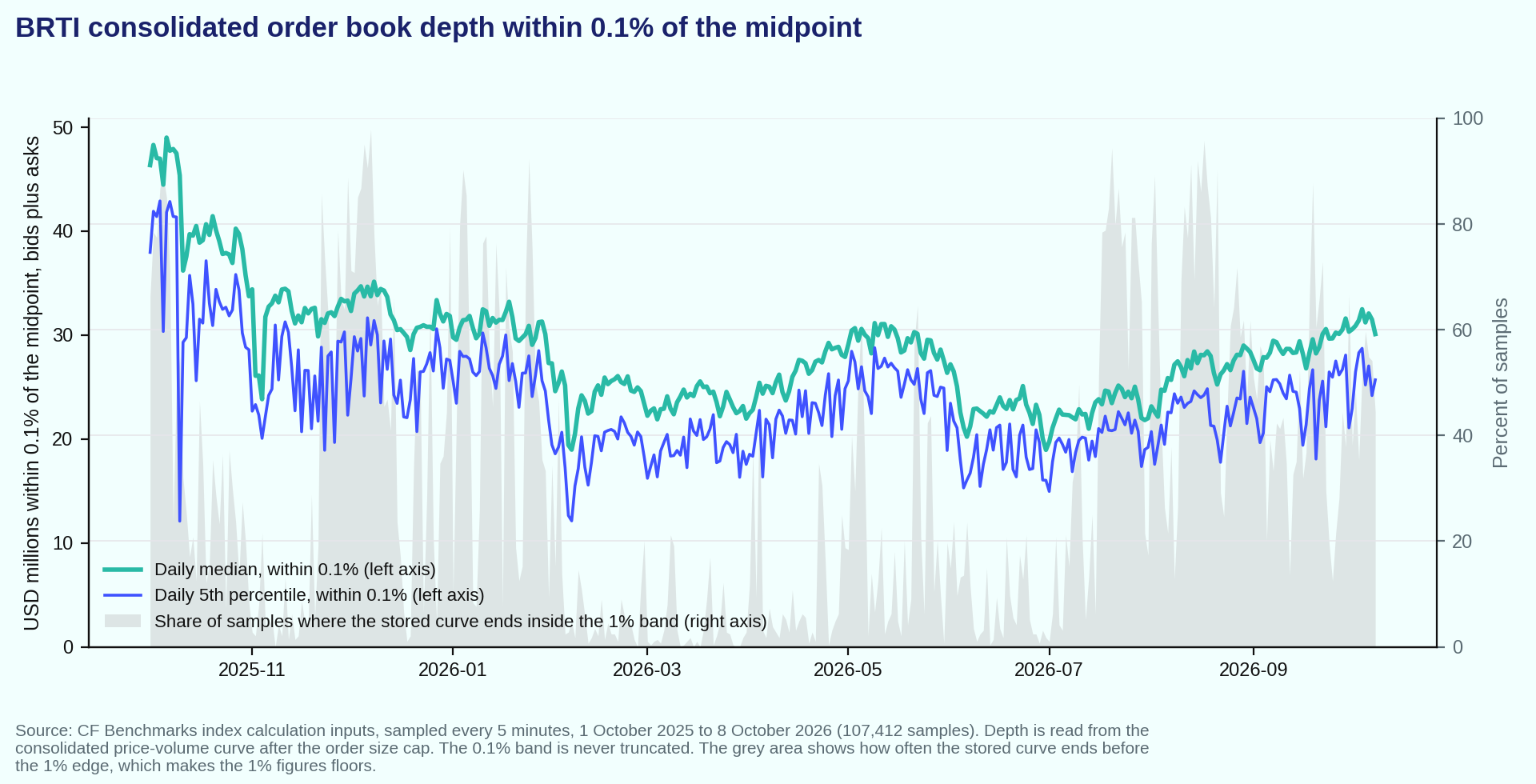
The BRTI calculates from the consolidated book, so we measure depth on the consolidated book. Between 1 October 2025 and 8 October 2026, the consolidated BRTI book held a median of $27.7 million within 0.1% of the midpoint, at least $64.3 million within 0.5%, and at least $71.5 million within 1%, bids and asks combined. At the 5th percentile, the 0.1% figure was $20.2 million and the 1% figure at least $55.3 million. Per side, that is a median of 178.5 BTC (about $13.8 million) within 0.1% and at least 461 BTC (about $36 million) within 1%. These figures come from CF Benchmarks' own calculation inputs, sampled every five minutes (107,412 samples). They read the consolidated price-volume curve the calculation uses, after the order size cap. The stored curve ends before the 1% edge in 31% of samples and before the 0.5% edge in 11%, so those two figures are floors. The 0.1% band is never affected. The share varies over time, from 4% of samples in March 2026 to 62% in August 2026 at the 1% band, so the 1% trend in Exhibit 3 partly reflects how much of the curve was stored, not only the book. Exhibit 3 therefore shows the 0.1% band, with the truncated share of the 1% band plotted alongside. Dollar depth also follows the bitcoin price, which had a monthly median of about $112,000 in October 2025, about $63,000 in June 2026 and about $85,000 in October 2026, so BTC per side is the cleaner comparison across months.
Depth is stable across the week. Within 1%, weekend depth was close to weekday depth, at a median of at least $70.4 million against $71.9 million. The headline figures above include every hour of every day in the window.
The BRR measures liquidity differently. It is calculated from trades in a one-hour window, so it reflects traded volume, not resting depth. We therefore use the BRTI for the depth analysis. The BRR appears in the section 1 table only.
How the methodology defends the price
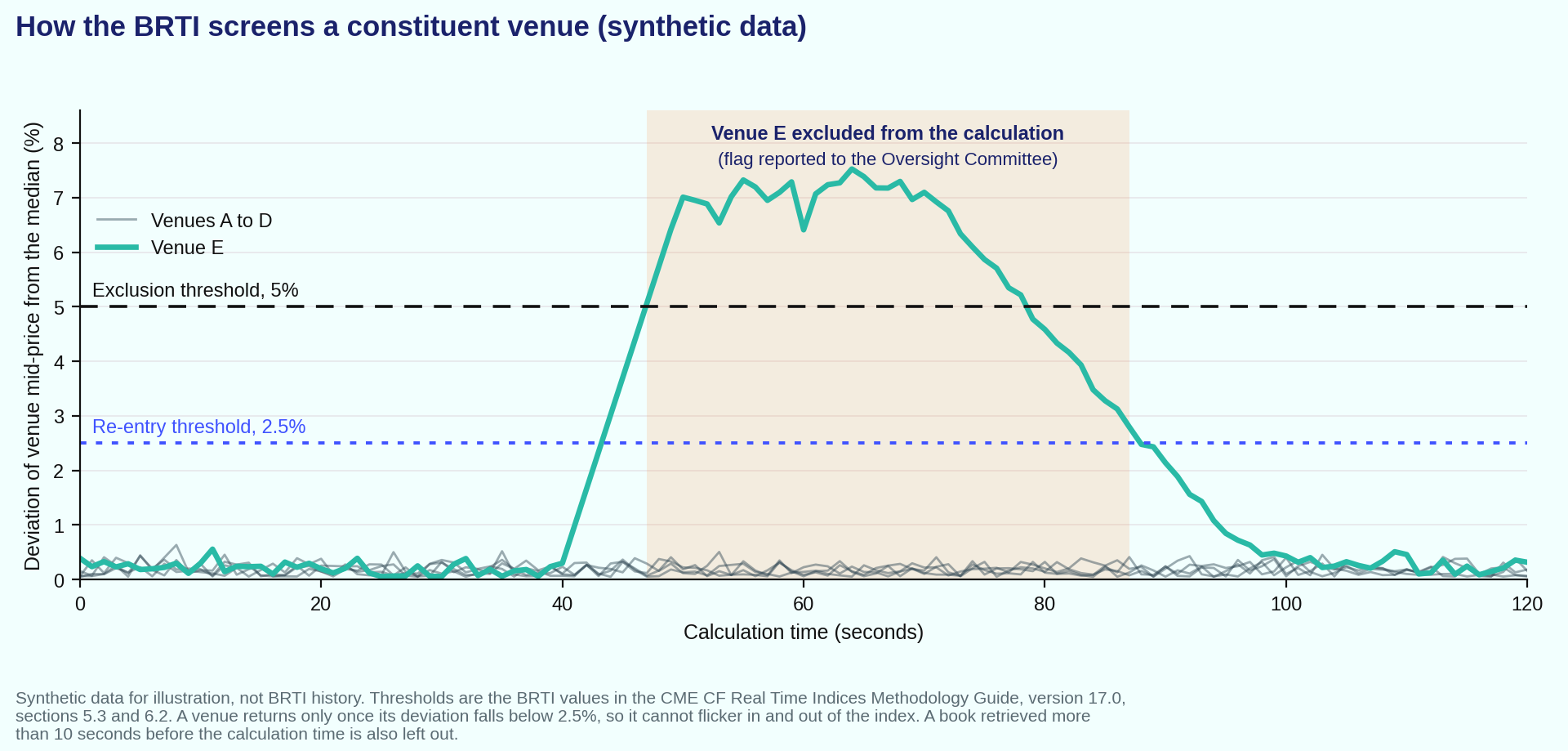
Depth is the first defense. The methodology is the second. The CME CF Real Time Indices Methodology Guide (version 17.0, 21 September 2026) sets the BRTI calculation time at every 200 milliseconds, as it has been since May 2026, and the BRTI is published every 200 milliseconds to every client with access to it. The screens apply at every calculation. The index consolidates the order books of all constituent exchanges and caps the aggregate size at any single price level of the consolidated book. A venue whose mid-price strays more than 5% from the median of constituent mid-prices is excluded, and it returns only once the gap narrows below 2.5%. Each such flag is reported to the Oversight Committee. A venue whose order book was retrieved more than 10 seconds before the calculation time is left out of that calculation. (Methodology v17.0, sections 4.1.1 and 4.1.3 for the consolidation and size cap, 5.1 for the 10 second rule, 5.3 for the deviation screen, 6.2 for the calculation time and parameters, and section 7 for dissemination. The 5% parameter and the 10 second threshold are the BRTI values.) Exhibit 4 illustrates the screen with synthetic data, labeled as such.
Venue contract design adds a third layer. Averaging 60 one-second values means a single bad second moves Kalshi's settlement value by one sixtieth of its size. Exhibit 5 illustrates the 60-second window with synthetic data. Together, depth, screens and averaging mean that moving a settlement price requires sustained size, not a single print.
The cadence also matters for onchain use. For the BRTI, publication every 200 milliseconds sits alongside Pyth's 200 millisecond option and Chainlink's sub-second Data Streams (section 5 table). The calculation rules do not change when the value is delivered through the oracle.
The cost of a narrow reference price
Two episodes show what a narrow reference price costs.
On 10 October 2025, Binance valued USDe, wBETH and bnSOL collateral from its own order book. USDe fell to $0.65 on Binance while holding near parity elsewhere and onchain, and positions collateralized with it were liquidated. Binance paid $283 million in compensation and added redemption prices to its index weights. In October 2022, a trader moved the thinly traded MNGO token from $0.03 to $0.91 and borrowed $116 million on Mango Markets against the inflated collateral.
In both cases the price source reported its inputs faithfully. The inputs were the problem. A price built from several venues, with exclusion rules that run on every calculation, does not remove that risk. It changes how much capital an attacker needs and which parties would have to move together. These episodes illustrate the reference price problem, not CFB Oracle coverage.
Who signs the price
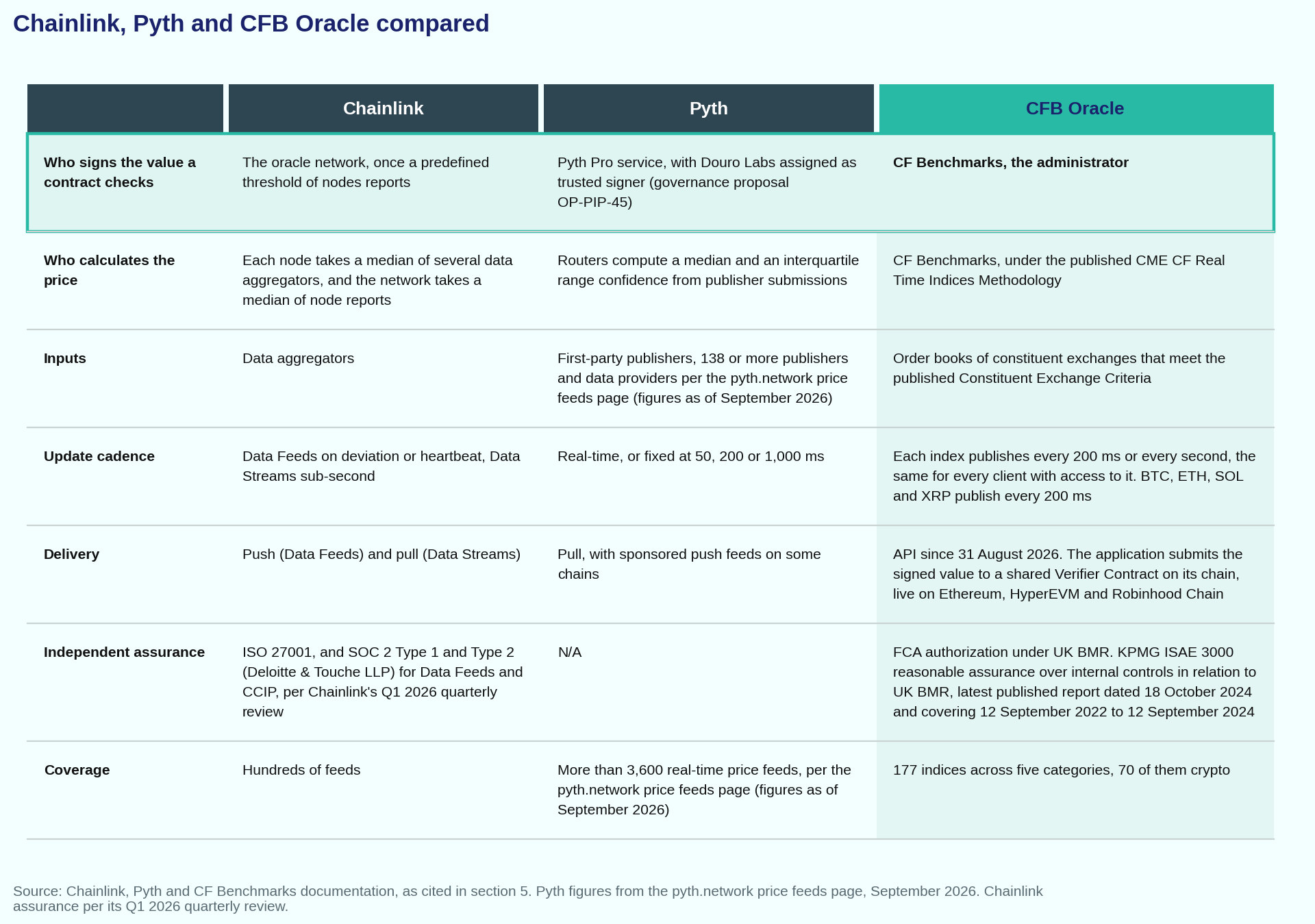
An oracle does two jobs. It calculates a price, and it delivers that price with proof of where it came from. Chainlink and Pyth do both. Benchmark administrators already use these networks for the second job: FTSE Russell, for example, publishes index data through Chainlink DataLink (announced 3 November 2025). In that model, as Chainlink's DataLink documentation describes it, the provider makes its data available through an API, several nodes in a Chainlink oracle network fetch it independently and reach consensus, and the network generates the signed report. CFB Oracle keeps both jobs with the administrator. CF Benchmarks calculates the value under its published methodology and signs it, so the signature a contract verifies belongs to the party accountable for the number.

Signing by the administrator creates its own risk. If one party signs, key compromise is the obvious point of failure. The design limits how long any key matters. CF Benchmarks registers its primary signing keys in the Verifier Contract on each chain, each with a fixed validity window, and registration requires proof that the key holder controls the key. Day-to-day values are signed by operational keys that a primary key certifies for 24 hours at a time. A primary key can be revoked or its window shortened, and verification can be paused, so a compromised key can be retired without replacing the contract (Zellic, Pull Oracle security assessment, 18 August 2026, section 4.1).
How delivery works
CFB Oracle is a layer on top of the existing indices, not a new set. Each value is produced in four stages: approved inputs from constituent exchanges, normalization, aggregation under the documented methodology, and delivery.
For each update, CF Benchmarks generates a payload hash from the feed ID, timestamp and value, signs it, and returns the signed value with the API response. CF Benchmarks does not write prices to a chain. An application that needs proof brings the signed value into its own transaction and calls a single shared Verifier Contract on its chain, which checks the signature against the keys CF Benchmarks has registered there and the value's age against the application's own limit. Zellic assessed the Verifier Contract, the signer registry and the payload authentication code between 3 and 6 August 2026 and reported three findings, all informational (Pull Oracle security assessment, 18 August 2026). Key custody was outside the scope of that assessment.
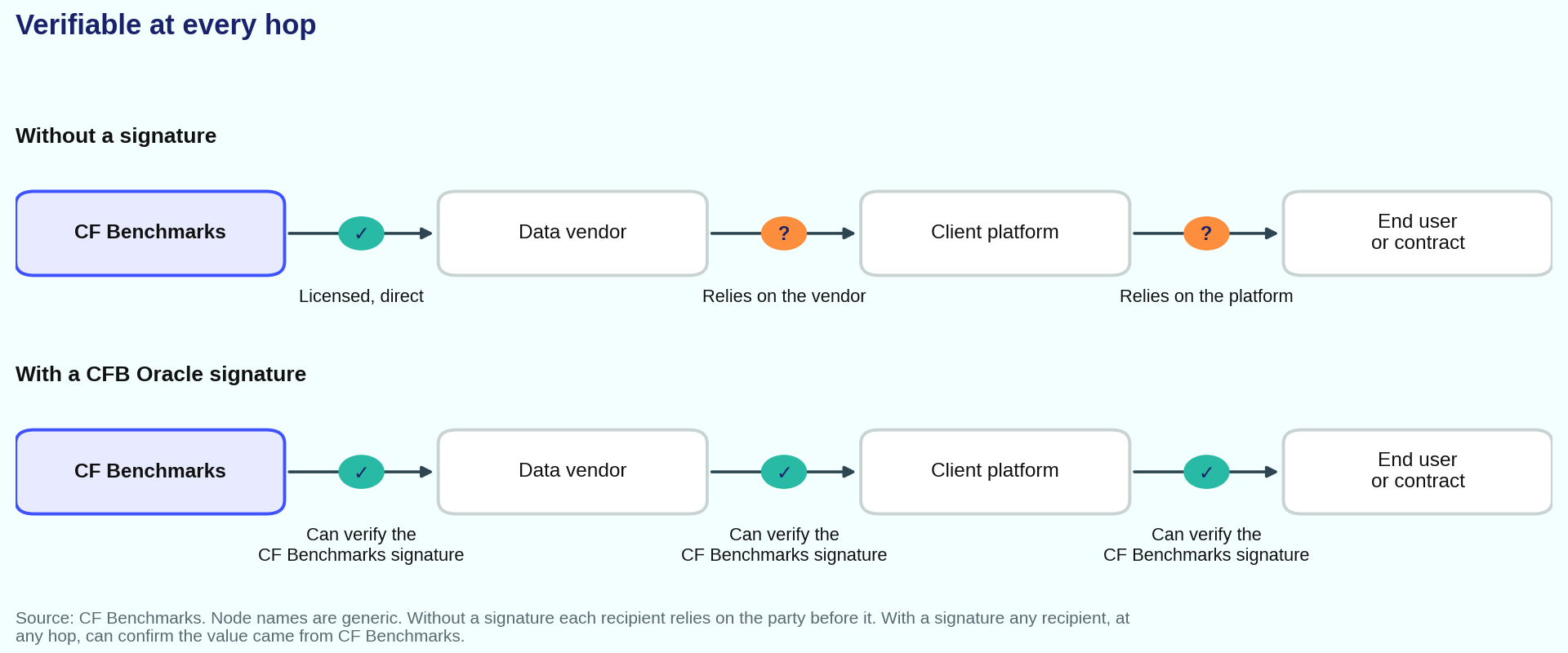
Two properties follow. First, any given calculation carries one value and one signature, whichever client or chain receives it. Each index publishes at one frequency, the same for every client with access to it: every 200 milliseconds for some indices, including BTC, ETH, SOL and XRP, and every second for the others. A client that wants the BRTI less often can set a parameter to receive it every second. In onchain markets, seeing a price update first has value, and liquidations are the clearest case. Second, provenance survives distribution. Market data rarely travels straight from administrator to end user. It passes through vendors, client systems and the client's own platform, and each recipient relies on the party before it to pass the number on unaltered and on time. A signed value removes that dependency. Any recipient, at any hop, can confirm that the value came from CF Benchmarks.

What builders can launch
The audience is builders starting new products, not operators migrating live ones. Three product types map to the evidence in sections 1 to 4.
Prediction markets have the most direct precedent. Regulated venues already settle crypto event contracts to the Real Time Indices, with 191 Kalshi crypto series naming CF Benchmarks as a settlement source (section 1), and onchain venues can offer the same reference with proof of origin. The launch set has 177 indices: 70 crypto, 89 equities, 7 commodity, 3 FX and 8 staking and rates. The Explorer listed ten of the crypto indices on 14 October: bitcoin, ether, XRP, solana, cardano, avalanche, chainlink, sui, litecoin and bitcoin cash (CFB Oracle Index Explorer, checked 14 October 2026). Tokens that onchain venues do not yet settle to a regulated index are an opening visible from the index list, though we have not sized it.
Perpetual markets launching new instruments need a mark and index price that holds up when volume is thin. The BRTI draws on seven constituent order books, applies the screens in section 3 at every calculation, and held a median of $27.7 million within 0.1% of the midpoint (section 2). Those properties reduce reliance on a single venue's book. They do not remove it.
Lending protocols need to value collateral. The cost of a narrow reference price in section 4 is a collateral valuation failure. A multi-venue index with published screens narrows that risk, though as section 4 notes it does not remove it.
Limits and disclosures
CFB Oracle has limits a builder should weigh. Coverage is 177 indices, 70 of them crypto, against hundreds of feeds at Chainlink and more than 3,600 at Pyth (section 5 table). The depth, screening and venue evidence in sections 1 to 3 covers the BRTI, not the other 176 indices. Verification is live on three chains, Ethereum, HyperEVM and Robinhood Chain, and is built for EVM chains only. Attested values reach clients through the API, and there is no onchain fallback. An application that needs one provides its own, as clients of CF Benchmarks indices do today. Use requires a commercial license, as with any CF Benchmarks index. The latest published KPMG report, ISAE 3000 reasonable assurance over internal controls in relation to UK BMR, covers the period 12 September 2022 to 12 September 2024.
CF Benchmarks is part of Payward, which owns Kraken and built Ink. Kraken is a constituent exchange and a source of input data for the BRTI, a relationship CF Benchmarks discloses on its website and in the constituent exchange list. The Constituent Exchange Criteria apply to every venue equally.
Beyond crypto: the wider index set
CFB Oracle carries indices outside digital assets, and the same signing and delivery design applies. The 177 indices at launch span five categories: crypto 70, equities 89, commodity 7, FX 3, and staking and rates 8. Sections 1 to 8 concern the crypto Real Time Indices, led by the BRTI. This part describes the other categories briefly, without timelines. We do not describe the construction of the commodity, FX, and staking and rates indices here.
Equities. The 89 equity indices at launch are calculated from tokenized equity order books, not direct exchange feeds. Integration with primary exchange data is a separate workstream outside this launch. Until that integration lands, we treat equity coverage as high level and do not publish liquidity depth for it.
Compute. The CF H100 Neo-Cloud GPU Compute Index (H100NCUSD_HRR) tracks the on-demand price of renting one NVIDIA H100 SXM GPU, in US dollars per GPU-hour. It is calculated every hour, every day, from quotes retrieved from approved provider and marketplace APIs across a panel of 15 neocloud providers, with hyperscaler cloud platforms excluded. Quotes that pass staleness, outlier and erroneous data screens are equally weighted, no provider carries more than 25% of the weight, and no smoothing is applied, so each value depends only on that hour's quotes. It is built as a reference rate for compute-linked products, including perpetual contracts (CF GPU Rental Series Methodology Guide, version 1.0, 28 July 2026).
Takeaway
For builders, the choice of oracle is increasingly a question about the reference price, not only the delivery. Chainlink and Pyth already distribute prices at scale, with hundreds of feeds at Chainlink and more than 3,600 at Pyth (section 5), so distribution is not where CFB Oracle competes. The open question for onchain markets that settle value is which price a counterparty, a clearinghouse or a regulator will accept when it is challenged. CF Benchmarks' view is that depth across several constituent order books that meet published criteria, a published rulebook and a supervised administrator that signs its own value are the better answer, and that a signature makes that answer checkable onchain. We will measure the view by adoption: which venues and protocols reference the indices through CFB Oracle.
FAQ
Is CFB Oracle a new index? No. It delivers indices CF Benchmarks already publishes, with the same methodology. The crypto Real Time Indices carry UK BMR oversight. The addition is a signature on every value.
Which chains are supported? Verification is live on Ethereum, HyperEVM and Robinhood Chain, all EVM-compatible, with more networks to follow.
What does a builder need? A commercial license covering use of the indices in the product, access to the CF Benchmarks API, and a call to the shared Verifier Contract on the chain where verification is needed.
How does verification work? CF Benchmarks signs a hash of the feed ID, timestamp and value. The application passes the signed value to the Verifier Contract on its chain, which checks the signature against the keys CF Benchmarks has registered, so the application can confirm the value came from CF Benchmarks without contacting CF Benchmarks.
The information contained within is for educational and informational purposes ONLY. It is not intended nor should it be considered an invitation or inducement to buy or sell any of the underlying instruments cited including but not limited to cryptoassets, financial instruments or any instruments that reference any index provided by CF Benchmarks Ltd. This communication is not intended to persuade or incite you to buy or sell security or securities noted within. Any commentary provided is the opinion of the author and should not be considered a personalised recommendation. Please contact your financial adviser or professional before making an investment decision.
Note: Some of the underlying instruments cited within this material may be restricted to certain customer categories in certain jurisdictions.
Who Signs the Price: The CME CF Real Time Indices Through CFB Oracle
CFB Oracle delivers the CME CF Real Time Indices onchain with a CF Benchmarks signature on every value. We measure the liquidity behind the BRTI, the screens that defend it, and how administrator signing differs from Chainlink and Pyth.

Mark Pilipczuk
Digital Assets Remain Flat as Tech Sells Off
Digital assets traded mixed over the week, ending flat after a midweek rally faded with equities. Breadth improved as smaller and diversified baskets steadied while the largest names lagged, implied volatility held as realized eased, and futures basis compressed across the curve.
Mark Pilipczuk
Factor Friday - Oct 23, 2026
Size led CF Benchmarks' factor table for a fourth week at 0.75% as the Market fell 1.88% and only 4 of 35 Broad Cap tokens closed higher. Liquidity turned negative at -1.03% as more liquid assets held up better, and Size's year-to-date lead extended to 23.74%.
Mark Pilipczuk
By clicking Accept, you consent to CF Benchmarks's use of cookies.
Visit Cookie Settings to learn how CF Benchmarks uses cookies and to adjust your preferences.