
Nov 03, 2026
Crypto Slides On Hike Fears And Binance Theft
Key takeaways for the month
We read October’s decline as a rates-led unwind that the Binance theft pushed below trend. The Federal Reserve held its policy rate at 3.75% to 4.00% on October 28 in a 10 to 2 vote, with Cook and Hammack dissenting in favor of a hike. Minutes of the September meeting had shown most officials saw a further increase as likely by year-end, and September inflation data supported that view, with core PCE rising to 3.1% year over year (YoY) and core CPI to 2.6%. The 10-year Treasury yield rose above 5.35% in the first week of the month before falling to 4.94% by October 30. Equities split, with the Nasdaq Composite down 5.3%, the S&P 500 down 0.9% and the Dow Jones Industrial Average up 1.7%. On October 29, a theft of about $6.3 billion from Binance hot wallets, the largest exchange theft on record, triggered roughly $1.5 billion of liquidations within 24 hours. All eight CF Benchmarks indices fell, and digital asset funds recorded their first monthly outflow since June. The Broad Cap Fear & Greed Index closed in fear territory. Network activity held up better than price. Across CME CF Crypto Market Index constituents, 30-day active users rose 12.6%, and Bitcoin’s hash rate returned above 1,000 exahashes per second (EH/s). Fees across those constituents fell 22.1%.
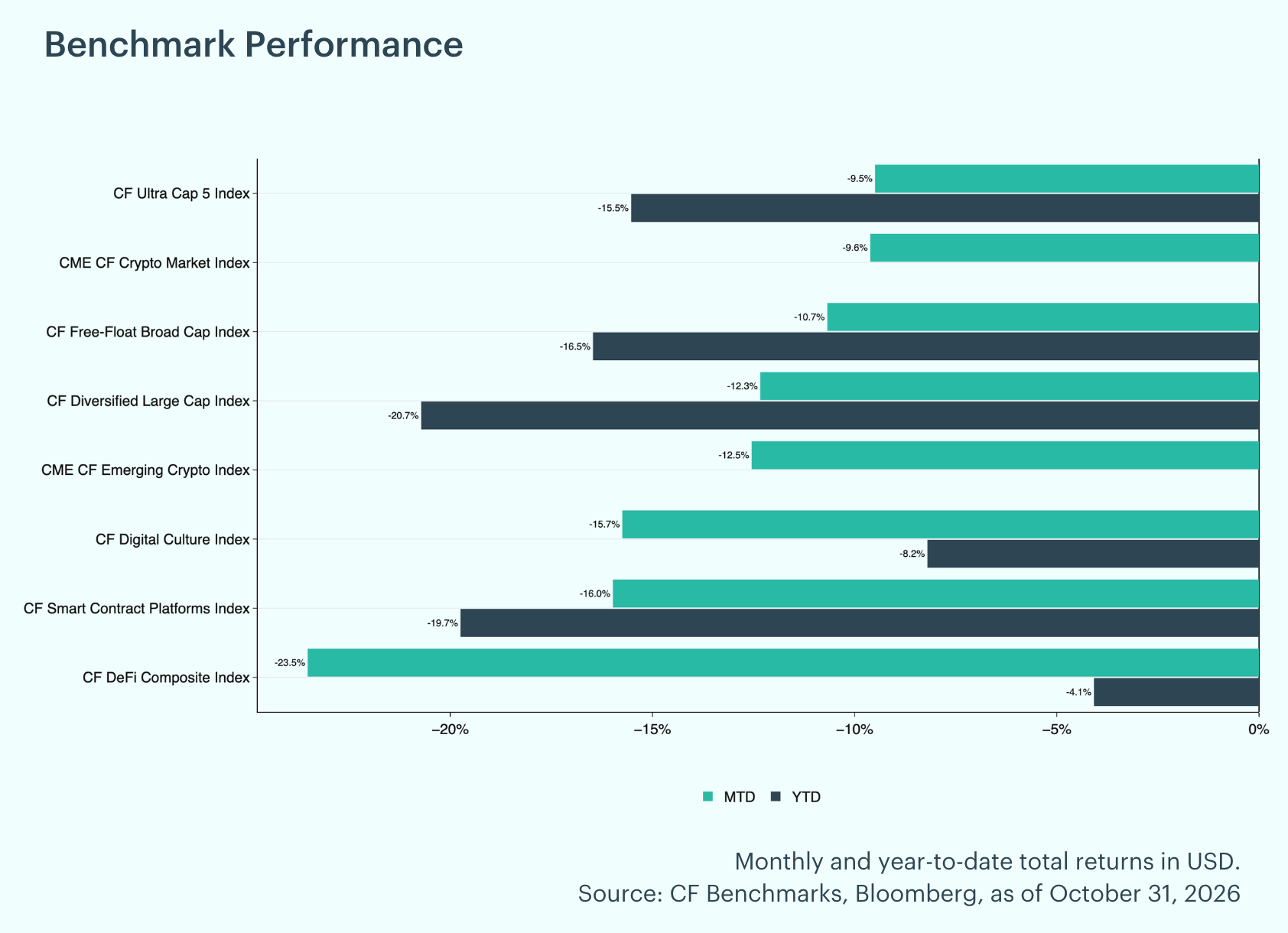
All Eight Indices Fall, With DeFi Giving Back Its September Lead: All eight CF Benchmarks indices fell in October. The CF Cryptocurrency Ultra Cap 5 Index held up best, down 9.5% month-to-date (MTD), followed by the CME CF Crypto Market Index (down 9.6%) and the CF Free-Float Broad Cap Index (down 10.7%). The CF Diversified Large Cap Index fell 12.3% and the CME CF Emerging Crypto Index 12.5%, while the CF Digital Culture Index lost 15.7% and the CF Web 3.0 Smart Contract Platforms Index 16.0%. The CF DeFi Composite Index, September’s leader, fell 23.5%, a 14.0 percentage point (pp) gap to the best performer. On a year-to-date (YTD) basis, all six indices with a full-year history are now negative, ranging from a 4.1% loss for the CF DeFi Composite Index to a 20.7% loss for the CF Diversified Large Cap Index. DeFi and Digital Culture, the two indices that turned positive YTD in September, both fell back below zero. The two CME CF indices lack a full year of history for a YTD figure.
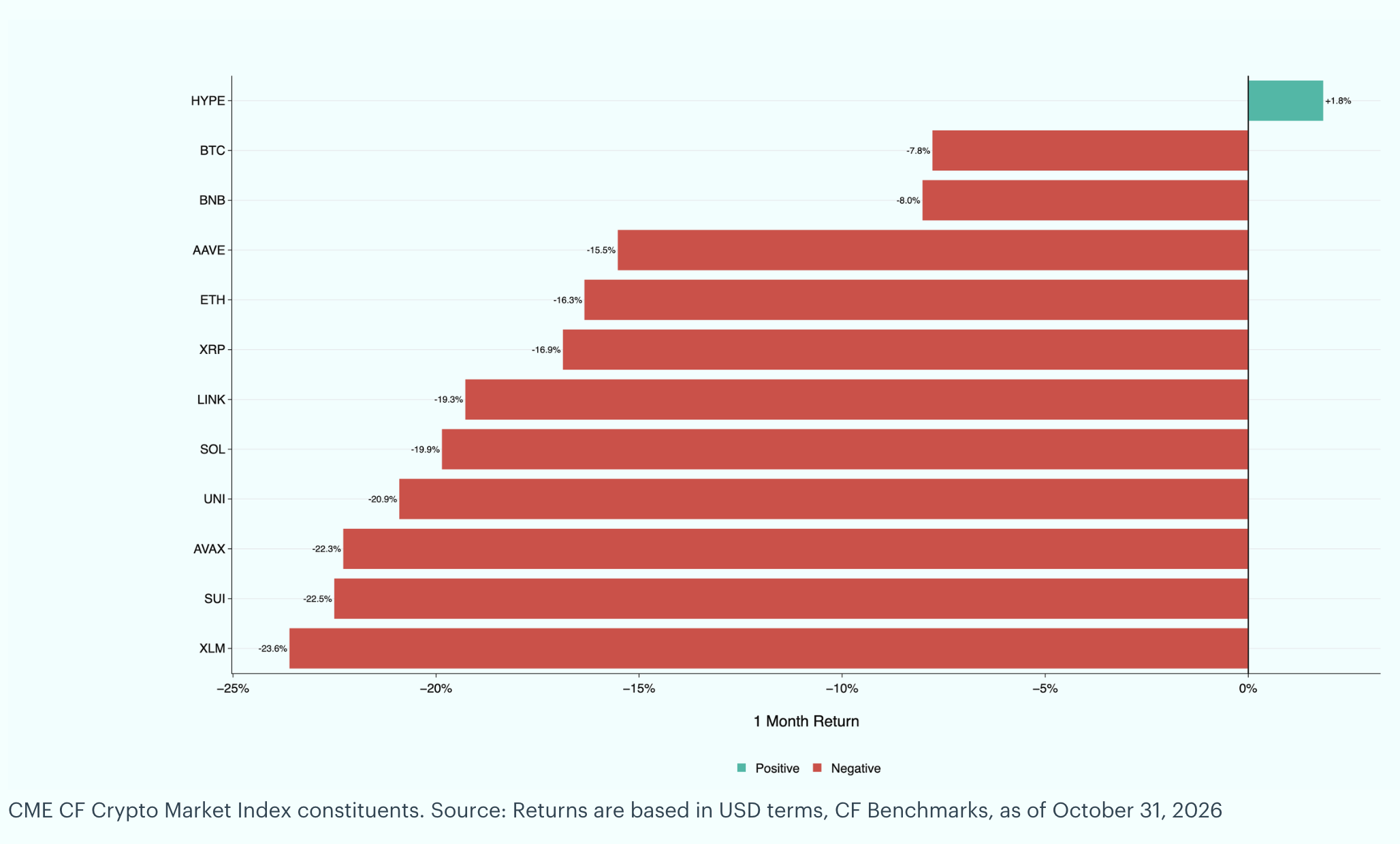
Hyperliquid Alone Gains as the Majors Sell Off: Hyperliquid (HYPE) was the only CME CF Crypto Market Index constituent to gain in October, rising 1.8% month over month (MoM). The protocol received $14.5 million in its first reserve yield payment on October 3 and directed it to buybacks. It also generated $67.9 million, or 67.7%, of the constituents’ October revenue, ahead of Uniswap at $8.3 million. Bitcoin (BTC) fell 7.8% and BNB (BNB) 8.0%, the smallest declines among the other eleven constituents. BTC dropped to $76,664 on October 29, the day of the Binance hot-wallet theft, while BNB completed a quarterly burn of about $1.2 billion on October 19. Stellar (XLM) fell 23.6%, the most among the twelve, followed by Sui (SUI) at 22.5% and Avalanche (AVAX) at 22.3%. AVAX was one of the chains involved in the theft, with attackers moving about 444,500 AVAX out of compromised Binance wallets.
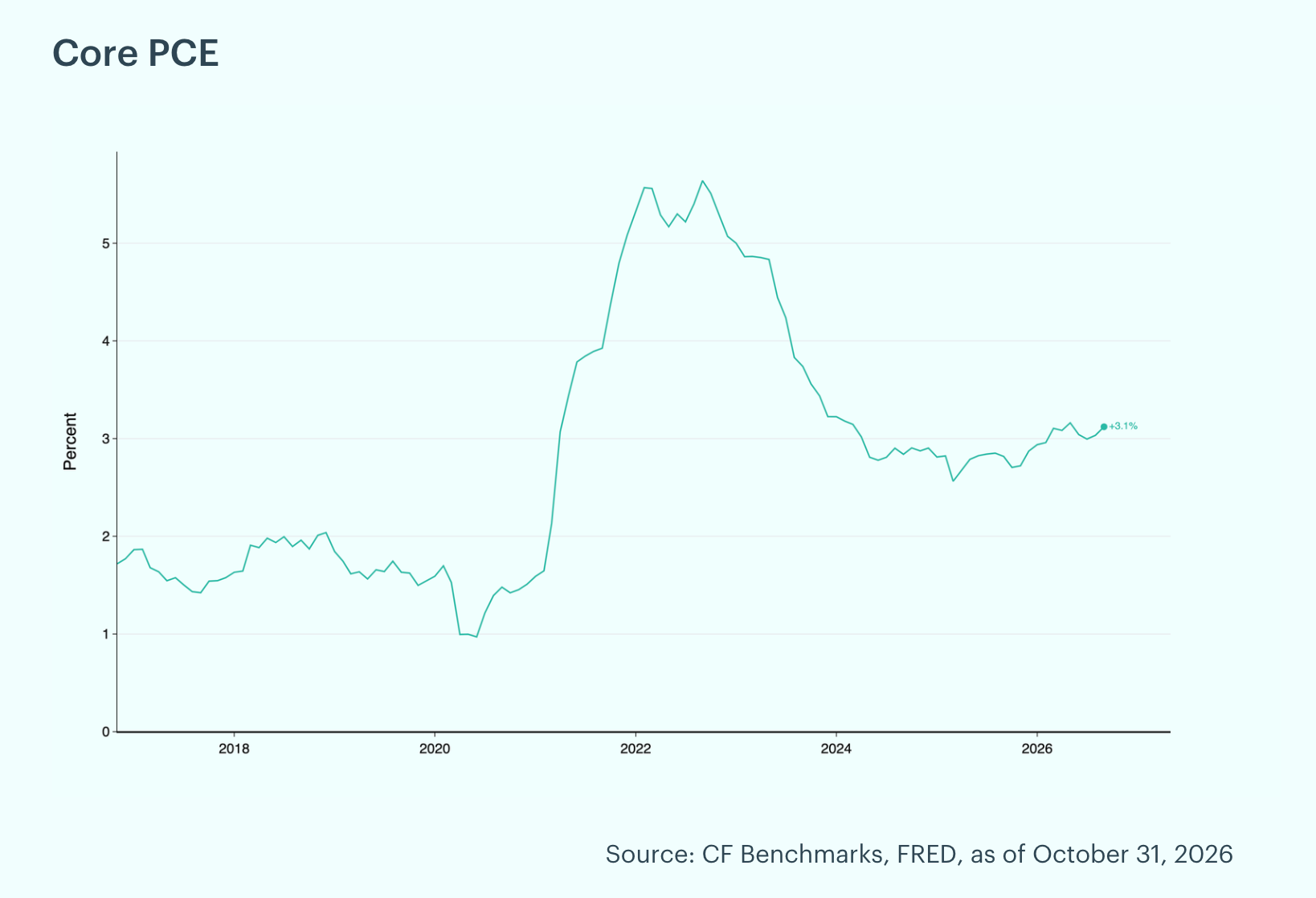
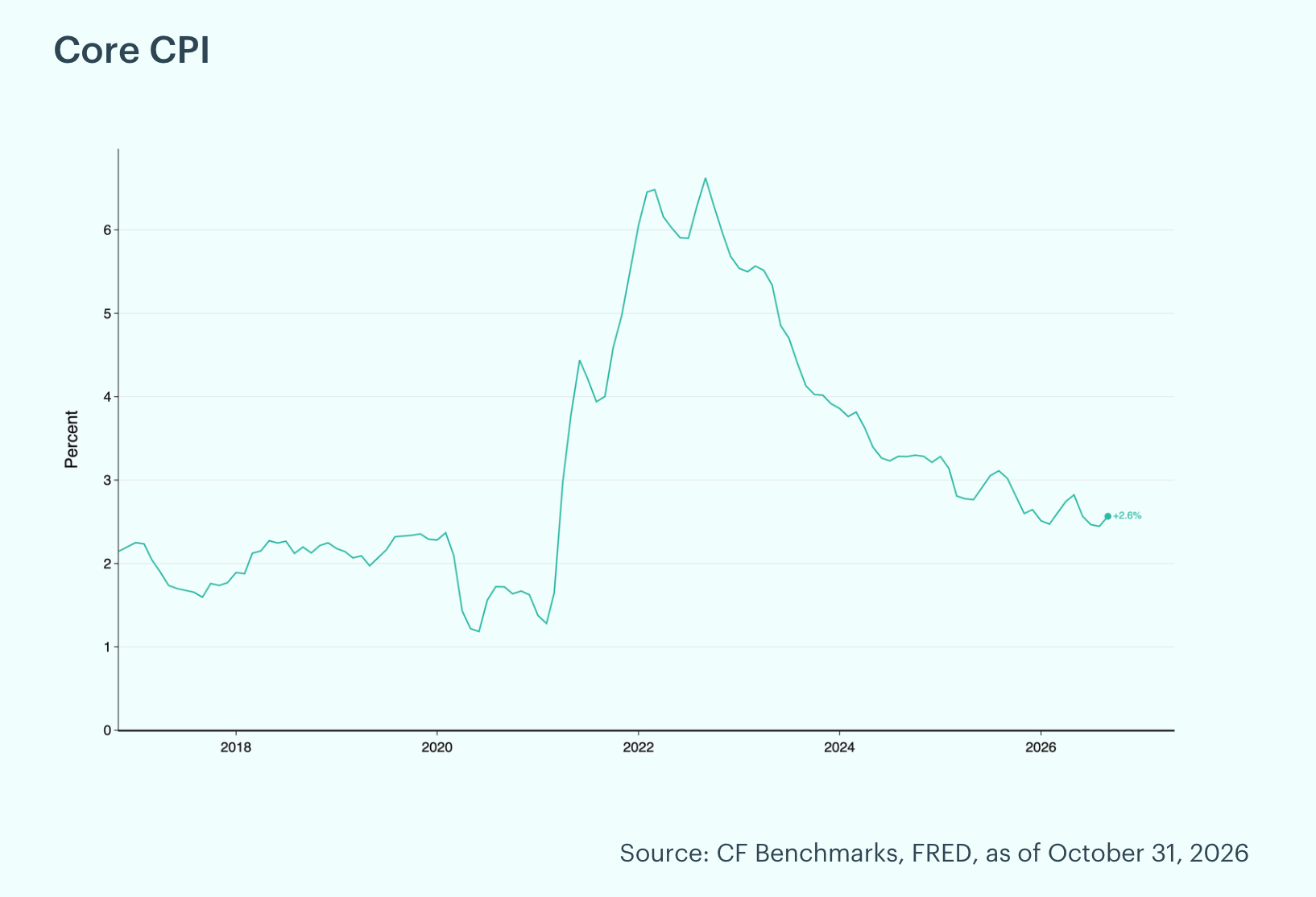
Core Inflation Turns Higher and Another Hike Remains Possible: The Federal Reserve held rates on October 28 with two members dissenting in favor of a hike, and the September data supported them. Core PCE inflation, the Fed’s preferred gauge, rose to 3.1% YoY from 3.0% in August, still more than a full percentage point above the 2% target. Core CPI climbed to 2.6% YoY from 2.4%, reversing August’s move to its lowest reading since March 2021. Headline CPI jumped to 3.7% from 3.4% as gasoline prices rose 9.1% on the month. Brent crude settled at $116.72 on October 23, its highest since April, as attacks on Gulf shipping intensified. Growth held up. Third-quarter GDP grew 3.4% and industrial production rose 2.2% YoY, its fastest pace since September 2022, even as payrolls added only 29,000. The Macro Regime Composite Score eased to +0.07, inside the neutral zone. A further move higher in either core measure would support the additional tightening that the September minutes signaled.
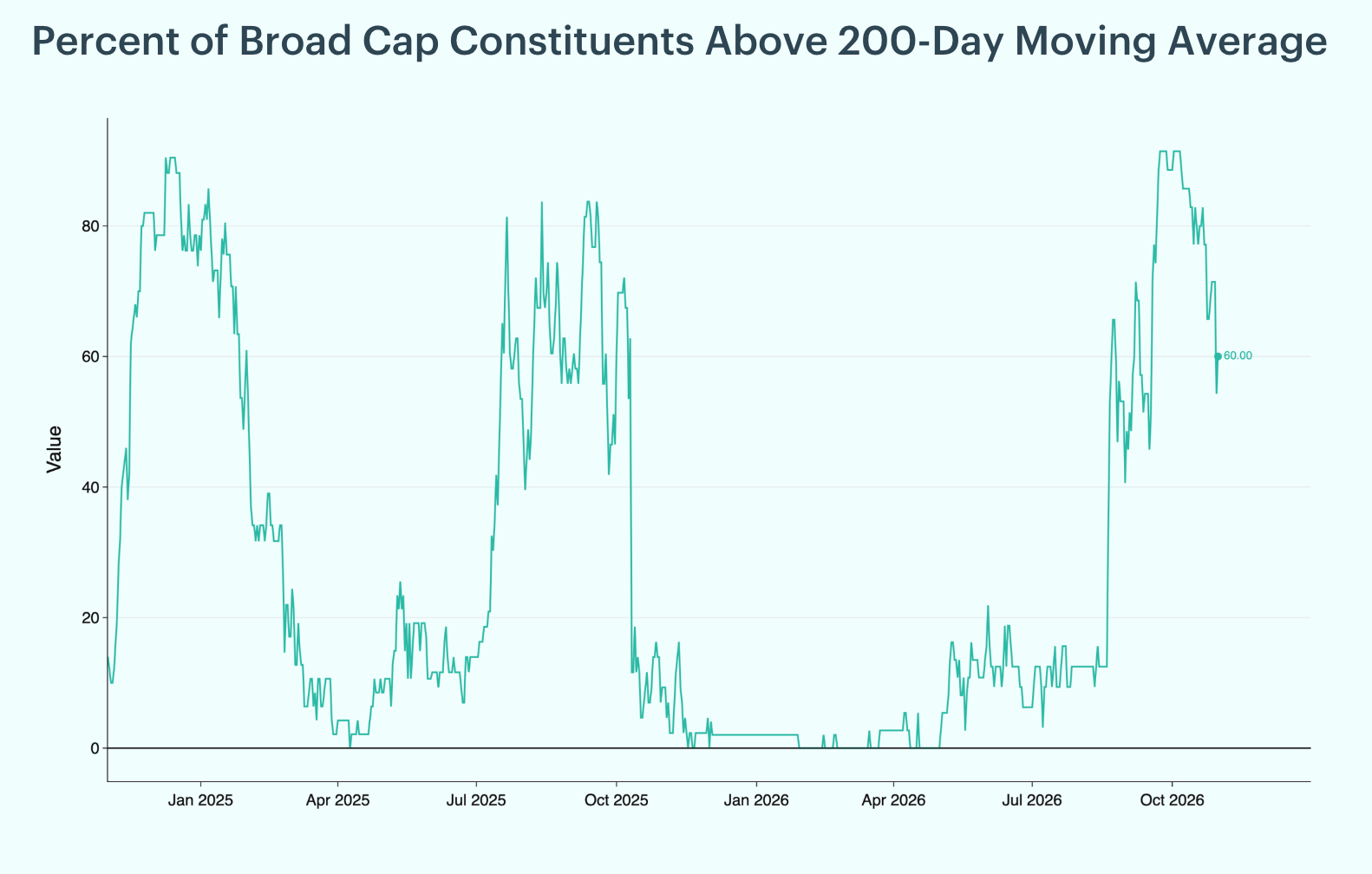
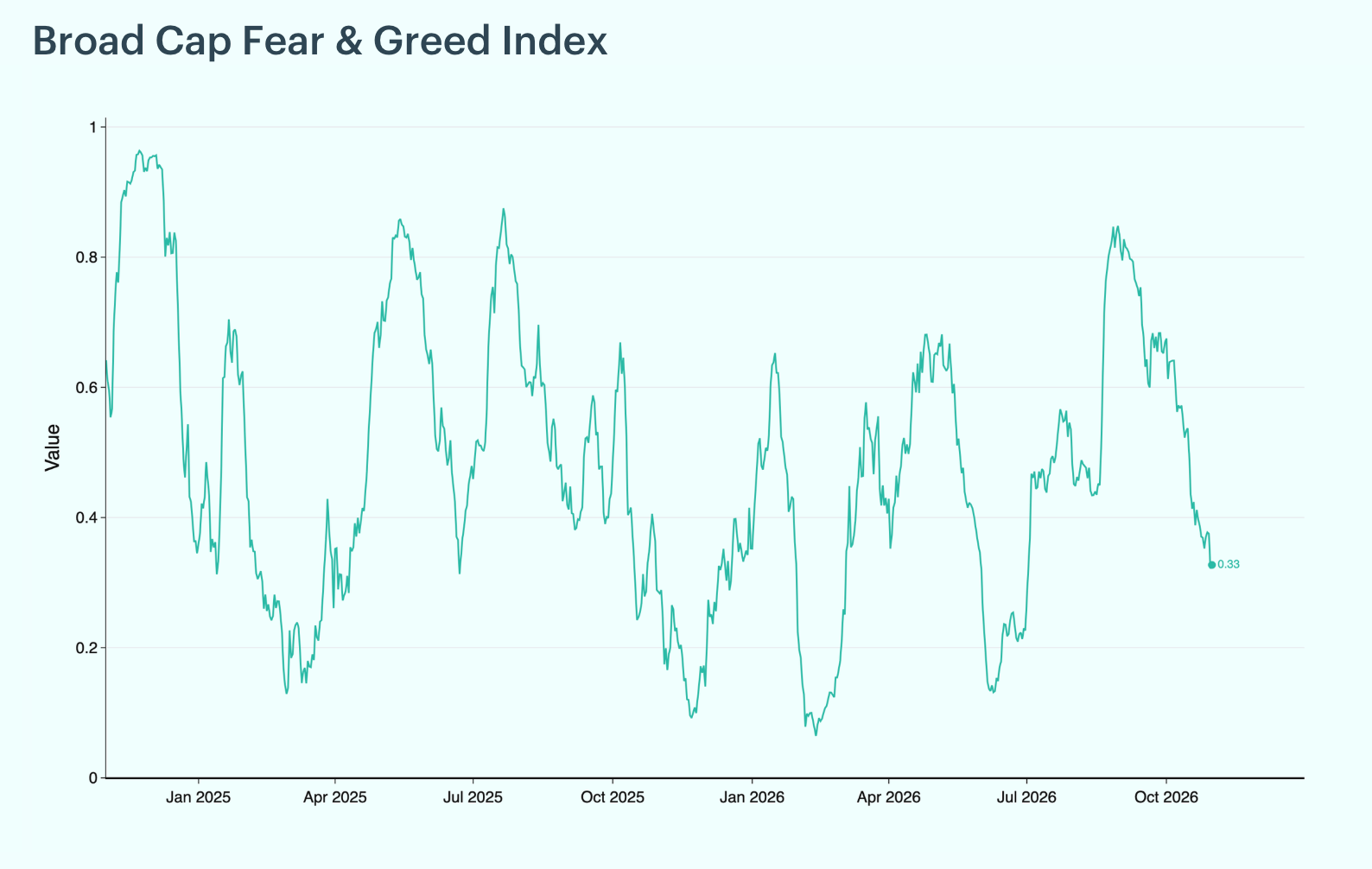
Price Falls Back to Trend and Sentiment Turns to Fear: The rally’s extension above trend unwound in October, and most of the unwind came before the theft. Broad Cap’s distance above its 100-day moving average narrowed from 21.8% at the end of September to 5.4% on October 29. It fell to negative 0.04% on October 30, its first close below the average since August 18, and ended the month at 1.0%. Participation narrowed in step. The share of Broad Cap constituents above their 200-day moving average peaked at 91.4% on October 2, matching the series high set in September. It fell to 54.3% on October 30 and closed the month at 60.0%, down from 88.6% at the end of September. The Broad Cap Fear & Greed Index, scaled from 0 to 1 with 0.5 as neutral, slid from 0.67 at the end of September to 0.32 on October 30, its lowest since July 2, and ended at 0.33, in fear territory. September’s smaller-cap leadership also reversed. The size factor’s one-year z-score fell from 4.31 to 0.07, and Quant (QNT) lost 31.3% on the month.
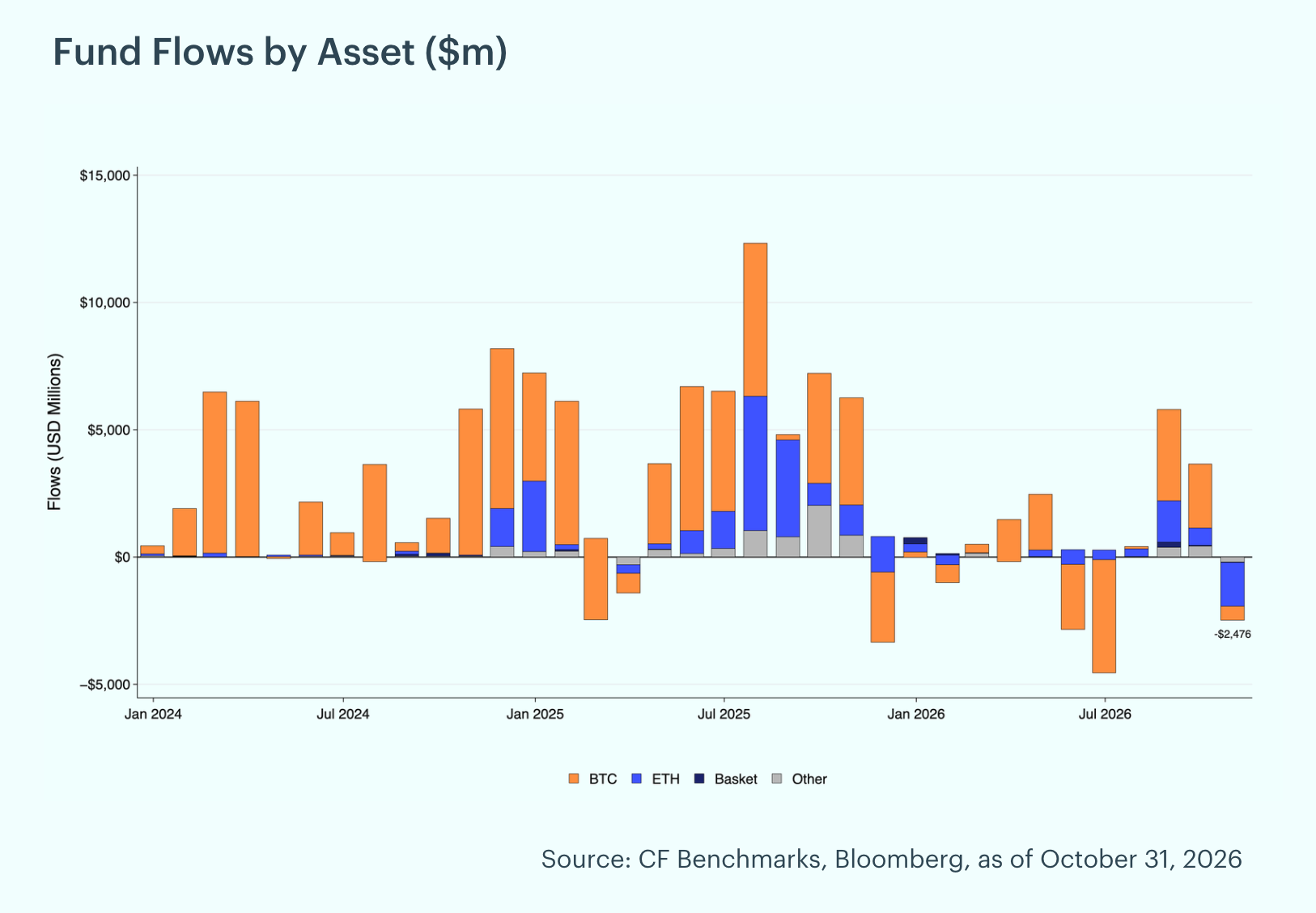
Fund Flows Turn Negative for the First Time Since June: Digital asset funds recorded $2.5 billion of net outflows in October, ending a three-month run of inflows and reversing $3.7 billion of inflows in September. Ether funds led the withdrawals at $1.7 billion, about 70% of the total, after taking in $673 million in September. Bitcoin funds lost $543 million after drawing $2.5 billion the month before, while Other Single Crypto funds shed $187 million and Basket funds $19 million. Ether outflows were more than three times those from Bitcoin funds.
To read the complete report, click here to view a PDF version. Additionally, please do not forget to subscribe to our latest news and research for the most relevant institutional insights on digital assets and the top digital assets by market cap.
The information contained within is for educational and informational purposes ONLY. It is not intended nor should it be considered an invitation or inducement to buy or sell any of the underlying instruments cited including but not limited to cryptoassets, financial instruments or any instruments that reference any index provided by CF Benchmarks Ltd. This communication is not intended to persuade or incite you to buy or sell security or securities noted within. Any commentary provided is the opinion of the author and should not be considered a personalised recommendation. Please contact your financial adviser or professional before making an investment decision.
Note: Some of the underlying instruments cited within this material may be restricted to certain customer categories in certain jurisdictions.
Crypto Slides On Hike Fears And Binance Theft
Digital assets fell in October as the Fed held rates with two dissents in favor of a hike and the $6.3 billion Binance theft pushed Broad Cap below its 100-day average. All eight CF indices declined, DeFi fell 23.5%, and funds recorded their first outflow since June.

Mark Pilipczuk
Changes to the Token Market Price Benchmarks Series - Market Prices – 03 November 2026
The Administrator has confirmed changes to the Token Market Price Family for the period 27 October 2026 to 03 November 2026.
CF Benchmarks
Binance Hack Turns a Post-FOMC Drift Lower Into a Sharp Decline
Digital assets gave back ground over the past week as the Binance hack, not macro, set the tape. Losses were broad, led by exchange-linked and high-beta names, while Hyperliquid stood apart. Defensive factors led, implied volatility repriced higher, CME basis widened and ETH staking rewards spiked.
Mark Pilipczuk
By clicking Accept, you consent to CF Benchmarks's use of cookies.
Visit Cookie Settings to learn how CF Benchmarks uses cookies and to adjust your preferences.